Categories
Uncategorized

Trucking by the Numbers in 2020: the Smallest Fleets Struggled the Most as a Great Driver Migration Occurred

2020 was a tumultuous year for trucking. The pain was felt everywhere, by everyone; but data show the smallest fleets likely felt the impact of the pandemic the most in our sector. For a decade, smaller fleets grew rapidly, successfully attracting drivers that the big fleets couldn’t reach or, simply, couldn’t hold. In fact, in the past decade — even into early 2020 — small fleets (1-100 trucks) added drivers at nearly a 2:1 ratio versus fleets of 500+ trucks. But all that changed in 2020.

After reaching the highest number of drivers ever in early 2020, the pandemic wiped out 163,697 of them from the nation’s fleet. Most of those gains, as shown by FMCSA data in early 2020, have not returned. By year’s end, 2020 closed with 7,096 fewer drivers than the end of 2019, however, that’s still a 5.3% decline from the heights 2020 reached early on.

The strong close to 2020 saw the spot market return. The chart below is notable in that it’s the first year the U.S. driver count was a net negative. But take look at the shift of drivers from small to large fleets. The losses in the 1-100 group represent a modest 4.4% reduction from the beginning of the year. But the gains in the 101-500+ group represent a more significant relative gain for them. The larger fleets gained 7.1% net drivers; in turn, increasing the capacity to serve their customers. This is some of what’s behind the bullish feeling regarding transportation stocks. Rates are up, and the large, publicly traded carriers can actually haul more than they could in 2019.
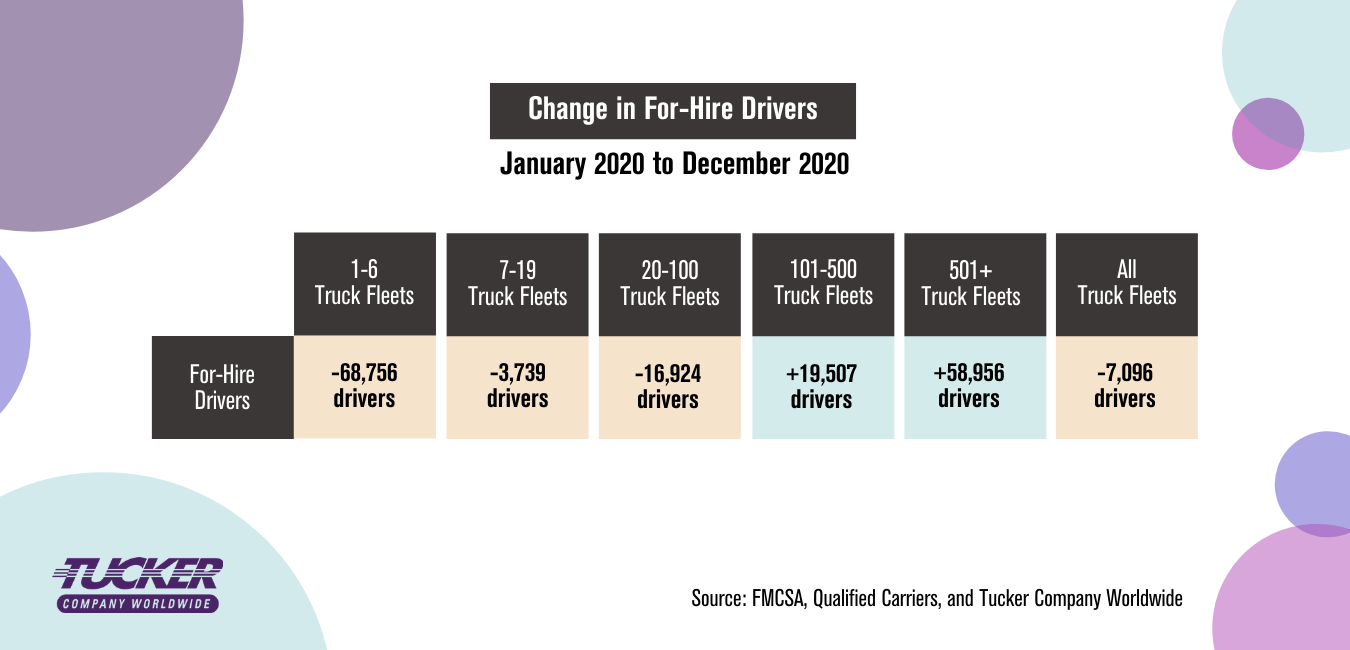
change in for hire drivers january 2020 to december 2020

But driver fortunes like these will be short-lived for large fleets the longer a recovery continues. It’s natural for drivers to seek shelter with large carriers until they feel like the spot market is back (and the spot market is back). But the inherent pioneering spirit of drivers, advances in technology, and affordable, abundantly available used trucks will make it easy to go back into business when combined with good rates.

Reports of bankrupt carriers may be interesting, but it doesn’t give a read on the marketplace. The more relevant data from 2020 is that the U.S. minted both new carrier growth and overall net growth in for-hire trucking companies. The chart below shows that there were 16,168 overall net new carriers ending 2020, than there were in 2019. That’s a 6.3% increase in trucking companies in business! We have also included data starting from July 2020 to show that this growth has not only been steady, but it’s actually accelerating in the small fleet segments.
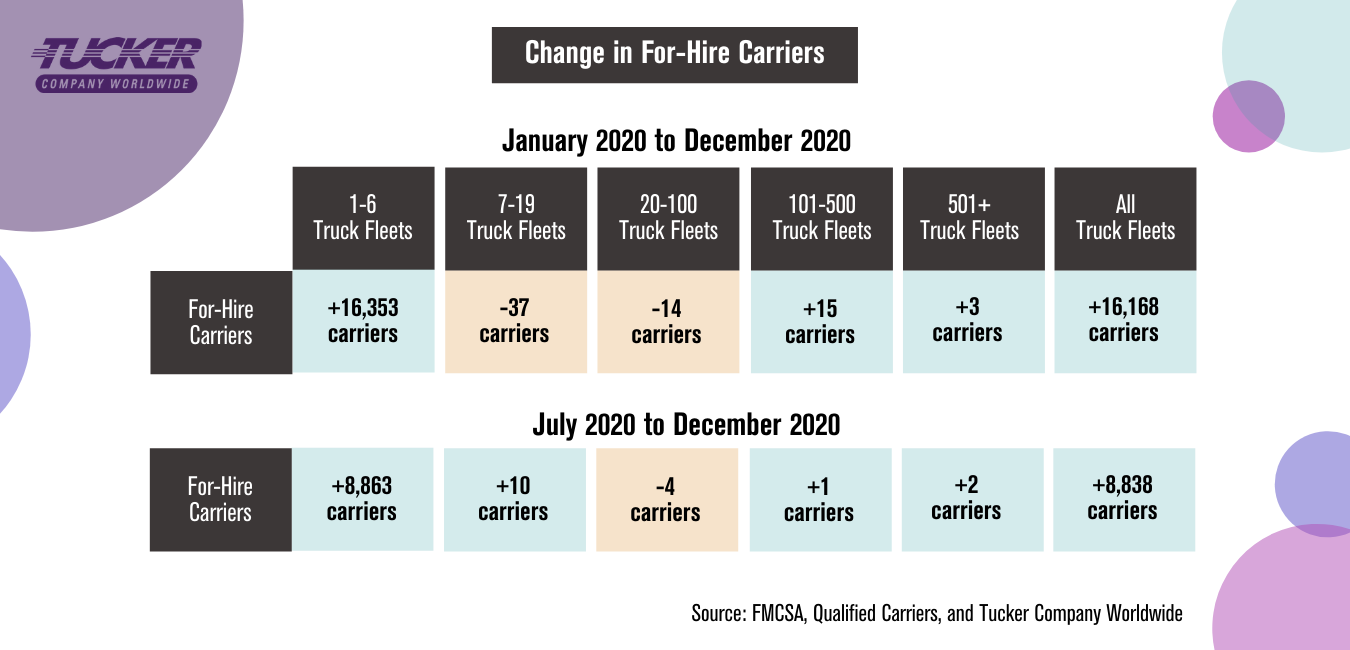
change in for hire drivers july 2020 to december 2020

Another reason to be concerned that larger fleets won’t be able to hold their recently won drivers is the used truck market. Large fleets, flush in capital through a decade of economic growth, added new equipment. The chart below shows the nation added significant new, net growth to trailers and tractors in 2020. In fact, there are nearly 500,000 more tractors than drivers — a fact sure to drive down the price of used equipment and tempt company drivers to scratch that itch to go independent. That growth in power units is notable, in that it’s 23% higher than when 2019 ended. Finally, that middle-market carrier segment continues to struggle in drivers, carrier counts, and equipment.
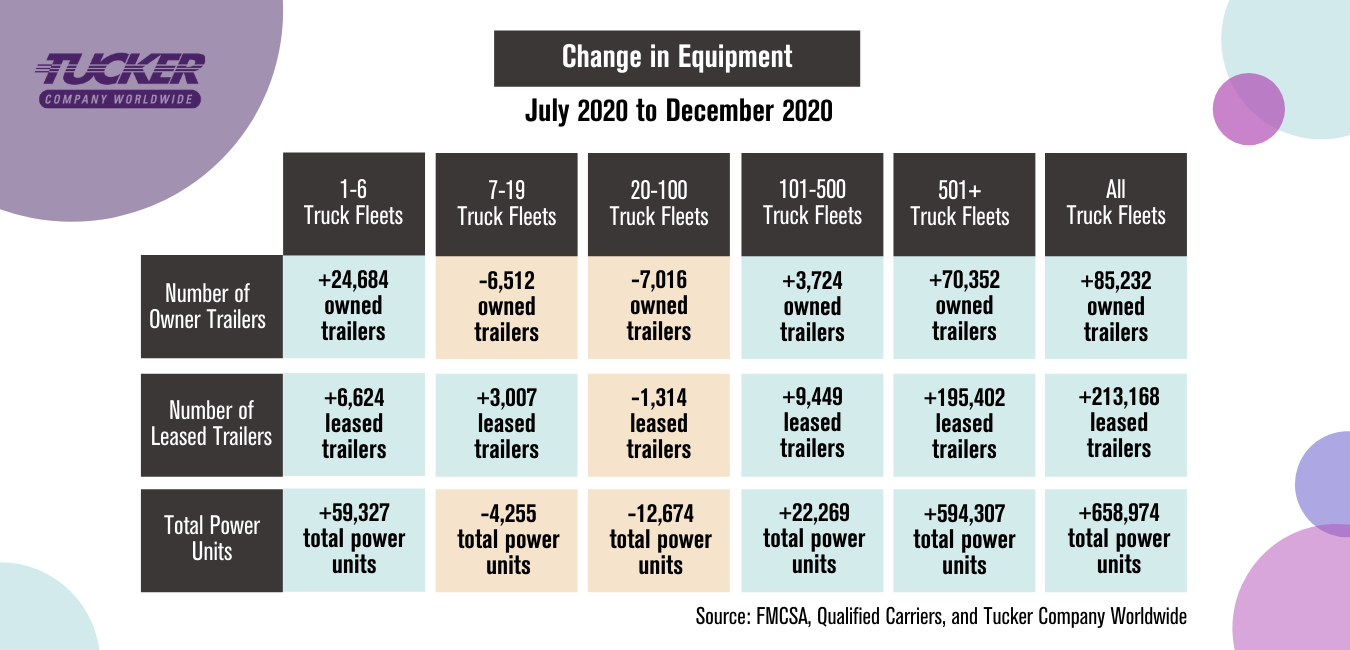
change in equipment july 2020 to december 2020

As we prepare to close out 2020’s 14th month, let’s hope that we can begin inoculating people faster, and get the millions of people in the most hard-hit industries (travel, restaurant, entertainment, hospitality) back to work — back to earning income and spending money again. When that happens, we’ll likely see another sustained surge in demand, caused by another significant shift in demand, shift in drivers, and shift in network design by shippers, brokers, and carriers of all sizes. We’ll keep sharing our data and insights.

About the data: Tucker Company Worldwide, Inc., and QualifiedCarriers.com have been capturing and analyzing FMCSA data, alongside many other monthly data points, since the beginning of 2012. The data is filtered to show only for-hire fleets that are active on the date the data is captured, and that have active authority and insurance on the FMCSA’s licensing and insurance database on that date. The filtered data seeks to count and represent all for-hire carriers that could conceivably be hired to move freight on the day of the data pull. Driver counts often lag a few months, as they are dependent on a number of variables including motor carrier census data. Motor carrier data is close to real-time, due to the nature of collection methods.

Categories
Uncategorized

FMCSA Data Shows 150,172 Fewer Drivers in 1-100 Sized Fleets Since June

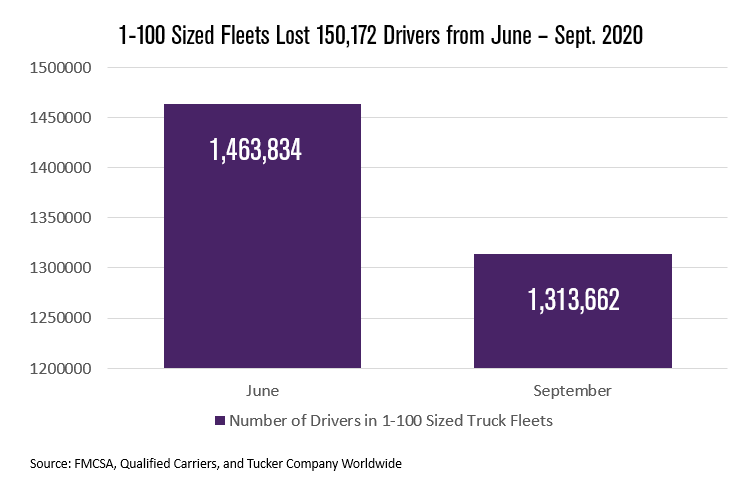
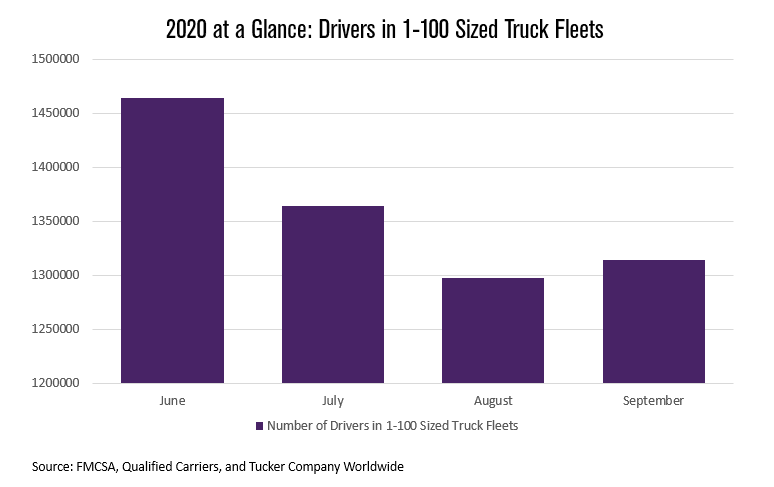
An analysis of data provided by the Federal Motor Carrier Safety Administration (FMCSA) and Qualified Carriers shows a decrease of 150,172 drivers from June 2020 to September 2020. That’s a 10.3% reduction in drivers at 1-100 truck fleets — a category that represents nearly half of all drivers on the road today. (There are 1,623,426 drivers remaining in fleets with more than 100 trucks.)

2020 at a glance: Drivers in 1-100 Sized Truck Fleets

1-100 Sized Fleet Lost 150,172 Drivers from June - Sept 2020

This is the largest downturn we have seen since we began analyzing this data in 2012. While it’s difficult to pinpoint the exact moment in time when these drivers threw in the towel (there tends to be a lag due to the self-reporting nature of driver data), it is evident that this is an unfortunate consequence of the events of 2020. The driver decline seems to coincide with the timeframe where unemployment subsidies ran out, so that may have played a factor, but the elephant in the room is that many owner-operators continue to operate without a solid customer base.

According to Truckstop.com, the majority of truckers using their product are looking for their next haul vs. a backhaul, meaning they are products of the spot market. Over one hundred years of their predecessors started businesses with at least one primary shipper customer. Starting a trucking company without a customer, and depending solely on the spot market and brokers as your primary or exclusive customer, is perhaps the riskiest business proposition in logistics. When things turn downward, there’s no safety net — no stability. We have been warning drivers about this for years, via radio, writings, and media conversations.

Unfortunately, as we reflect on April and May of this year, as the pandemic shut down much of the economy, we saw the negative consequences of these highly leveraged drivers. In April, data shows that nearly 25% of all U.S. truckload shipments disappeared and load tender acceptance rates (the percent of first-time shipment offers from shipper TMS’s to their primary carriers/brokers on a particular lane) were at nearly 100%. That meant the second or third provider on the shipper’s list never got a call, and therefore very few loads ever entered the spot market. So, if you’re an owner-operator without shipper customers, depending solely on the spot market, maybe 75-90% of your shipments disappeared. Against this backdrop, it is no wonder that many drivers exited the business, at least temporarily.

It’s important that shippers remain aware of this shift in the makeup of the freight transportation marketplace — especially as they decide how they’ll spread their volume in both good times and bad. When shippers give asset-based providers all of their volume, they’re inherently prioritizing the larger fleets and, hence, deprioritizing owner-operators. (It’s important to note that the average-sized fleet in the 1-100 category is only about 6 trucks, meaning there are significantly more owner-operators in this group than one might think.) When 4.7% of all capacity is lost, you’ll see escalating prices thanks to a driver shortage.

A healthy freight transportation marketplace is a balancing act: shippers need to be nimble, flexible, and insist that their procurement teams prioritize scalability by incorporating a healthy mix of reliable brokers into their awards. This will save them from overpaying when the spot market skyrockets and many of their larger carriers leave for greener pastures, which always happens in upturns.

Carriers simply must recognize the importance of having at least some core shipper customers who depend on their service and try to use load boards as more of a backhaul. They were never meant to be used exclusively to operate your business. When you ride a wave, as many carriers have recently, you must be prepared to crash ashore. Build that shipper customer base. Don’t operate solely off the spot market.

Until shippers and carriers change their operating behaviors, we’ll keep seeing capacity crises and market volatility, as we’ve experienced for the past six years, and shippers will need to be able to quickly adapt.

Need help navigating a capacity crisis? Contact us today!

Categories
Uncategorized

12 Days of the 2020 Holidays

12 Days Of The 2020 Holidays Inforgraphic

Categories
Uncategorized

Why Freight Digitization is 10+ Years Away From Being What Service-Driven Shippers Need

By Jeff Tucker, CEO, Tucker Company Worldwide

There’s a lot of hype in the transportation industry today around the digitization of freight. It’s a theme that’s dominated headlines the past few years and caused billions of investment dollars to flow into the industry as investors and startups seek to “Uberize” the industry, assuming freight transportation resembles moving passengers.

Certainly, the next digitally-led transformation of the freight industry is well underway and will continue to be in earnest for the next several years. It’s only a matter of time until we take a page from the Human Genome Project and identify, map, and analyze the several hundred data points within each transaction, the prior transactions, and the potential future ones. But we’re further away from that than many think. And we’re much further away than Wall Street and private equity investors believe.

While I don’t work for Uber, Convoy, or any other of the many startups, I have strong feelings about how they could have revolutionized the industry, and how they’ve swung for the fence and missed in spectacular fashion. I don’t see this transformation coming from the outside. There’s a place for almost any new startup with a solid business plan, just like there was a place for freightquote.com way back when. You see, I see the transformation coming from within — from the actors already dominating the marketplace: the freight brokers and forwarders of today.

Why? Well, first, we have the volume, customers, and systems. Second, and more importantly, we know what the “disruptors” still don’t seem to get — that the customer wants service that’s customized to them and their business needs. Third, we know that if getting good, decent, or even “somewhat adequate” freight service was about hooking a load to an empty truck, this business would be easy, and it’s not.

The customizations each sophisticated shipper needs today flies in the face of those who advocate for the “democratization of data” or the watering down, commoditizing of the industry’s justified diversity. This, coupled with the fact that there are 250,000+ (and growing) active for-hire carriers in the U.S., demonstrates the infinite and accelerating complexity of trucking service.

Most disruptors, and even “tools only” tech startups, have focused on improving back-office broker efficiencies seemingly without any regard for the intensive service performance demands and customization that today’s shippers demand. They make the assumption that all truckers are the same and all freight is the same, which couldn’t be further from the truth. Differentiation among trucking companies is almost impossible to underestimate. You just can’t build a business model that ignores the customer’s needs, regardless of the sizzle and sparkle.

Of course, price is always a huge consideration for shippers (and a huge selling point for the digitization of freight), but cost is constantly being wrung out of the transaction costs in a number of ways, none of which have the shipper’s best interests in mind, and don’t improve service, in an increasingly service-intensive and service-required industry.

Today’s mad dash, hair-on-fire rush to digitizing freight brokerage is almost entirely cost-focused. It ignores the most important part of any transportation service: what the customer needs. It’s not customer-centric at all … it’s broker-profit-centric. What value have we placed on the customer? What value on customer-specific needs? Shippers are tired of fitting into a mold their providers make. They want it the other way around.

Our customers don’t want frictionless freight connections that don’t perform. I can only imagine the response if one of my account managers asked a customer, “Do you mind if I send in a trucker we don’t know, may never use again and haven’t bothered to speak to about your freight?” We’d be fired!

Shippers today are more sophisticated than ever before. Their service needs are more differentiated and individualized than ever before. Two shippers using the same TMS, shipping similar products to the same customers have different service and data expectations, requiring modifications. Those modifications don’t lend themselves easily to brokers placing blinders on, finding the nearest available truck.

Most of the digitized frictionless freight market changes will occur in markets where their top three priorities are price, price, followed closely by price.

I’m talking about products that are commoditized, like building materials, lumber, sheetrock, metals, and other raw materials where freight literally breaks a deal, service isn’t important, and they’ll deal with any potential ramifications for the sake of a dollar. Frictionless freight digitization will also get its hold with some small shippers where shipments are transactional and, frankly, performance doesn’t matter.

It won’t happen with important freight like pharmaceuticals or groceries, where timeliness is rewarded and lateness is punished. I don’t see it happening in hazmat or over-dimensional freight, and I can’t imagine fashion or consumer electronics shippers throwing all caution to the wind.

For these industries, many of which are moving high-value, high-security goods, digitization platforms would have to offer a customized experience that takes millions of data points into account. We’re 10-15 years away from having enough data gathered; and even then, we’ll have primarily carrier and broker data.

The transportation industry is rushing headlong into the future. It always has been, and always will be. But too many of us are quick to overlook the most important details that make all the difference in the world: follow the customer’s needs, build technology around those needs, and we’ll ride the technology wave for many years to come.

Categories
Blog Capacity

5 Must-Ask Questions When Selecting a Third Party Logistics Firm

Shippers today are navigating an ever-changing, increasingly complex transportation landscape. Over the last 40 years, since the deregulation of the freight marketplace, there have been several capacity crises. The majority of these crises have taken place since 2014. Change is happening at a much more rapid pace today than ever before, and the faster shippers recognize these trends and adapt, the better they will fare in the next capacity crisis.

Brokers, or third party logistics firms (3PLs), can be a great partner in both good times and bad, helping to add steady capacity and consistency on your loads. However, not all 3PLs are created equal, so it’s essential to select your transportation partners wisely, as you would any large, trusted carrier partner.

The following questions can be used as a starting point to help you separate the wheat from the chaff.

1. What does your carrier base look like?

Many brokers — especially the largest ones — leverage owner-operators for the lion’s share of their shipments. That means that their customers are rarely getting the same company twice, let alone the same driver. When selecting a 3PL partner, find one that feels like a “core carrier” and provides whatever capacity you need.

What does this look like in practice? Your 3PL should leverage small, medium, and large fleets. When one of the aforementioned broker’s drivers falls off a load, they have to start over. Whereas a broker that uses medium and larger carriers is able to cover potential delays with another driver from the company. It’s an enormous difference in the quality of service and performance.

2. How can I expect to receive updates on my loads?

Visibility is King (or Queen!) nowadays. If you’re like most shippers, you want key information about your shipment at your fingertips at a moment’s notice. A good 3PL will ensure you can receive this information in whatever way is most convenient to you, 24/7/365, including via phone; email; a self-service portal; or API, GPS, EDI, and XML feeds. You may also want to inquire about their reporting capabilities. Ideally, you’ll find a broker that will take it one step further to provide shipping data on your lanes — helping you improve your business processes and operations, and identifying valuable cost-saving opportunities.

3. What is your tender acceptance ratio?

Commitment is key in brokerage. Thousands of brokers’ businesses are based upon the ideal that if they cover 80% of the loads on their boards, they made money on 80%. If you’re a shipper and your load(s) are in that 20% that the broker didn’t, couldn’t, or wouldn’t cover, where does that leave you? Like any business, brokers are in business to make money. (And your broker should make money … If they do a great job, you want them in business year after year to support you, after all.) But you have to find a broker that values relationships, practices solid business principles, and commits to your volume. That’s a small minority of the overall marketplace, and it makes a huge difference.

4. What measures do you have in place to ensure the safe, successful delivery of my goods?

Any broker worth its weight in salt will be able to clearly outline for you their careful carrier selection process and the ways in which they continuously evaluate and monitor their carrier’s operating authority. You want to find a broker that will verify each and every carrier’s USDOT and FMCSA profiles, their compliance performance, and their insurance. The 3PL should also require that their carriers execute a written broker-motor-carrier agreement, and maintain copies of those documents to verify their compliance. (Consider it an added bonus if the broker also has customer-specific standards of care, or SOCs, and work instructions for each of their clients!)

 5. In the event of a claim, how do you manage the process?

At the end of the day, the carrier moving your freight is the party that is held liable in your contract. This doesn’t change when you introduce a broker to the mix. That being said, you want to make sure the broker you’re considering working with won’t just dust their hands off in a “not my problem” type of fashion. Ideally, the 3PL will have a general counsel and staff to help process your claim, and have insurance policies in place that back up the carrier’s position. If that is the case, you may actually have more protection working with a broker than dealing with a carrier directly. We’d recommend asking to speak with the 3PL’s risk management team to discuss this in further detail.

A few other considerations that should certainly be top-of-mind for you as you select a 3PL are factors like their company history (both financials and longevity are considerations), their on-time percentage for both pick-up and delivery, and customer satisfaction metrics. You want to make sure your transportation partner is in it for the long haul.

Need help with your truckload or managed-LTL needs? Send us a message at info@tuckerco.com. We’d love the opportunity to win your business.

Categories
Uncategorized

ICYMI: Highlights From Road Dog Trucking News’ Deep Dive With Jeff Tucker

On Monday, our CEO, Jeff Tucker, joined Mark Willis for a special two-hour deep dive on SIRIUSXM’s Road Dog Trucking News. Didn’t have a chance to tune in? Check out our recap below:

The market today is like riding the newest and fastest rollercoaster — blindfolded.

The United States’ 2020 second-quarter GDP declined 32.9%, which is more than three times worse than any quarter in American history. The previous record for a GDP contraction was 10% in 1958. Few, if any managers were managing 62 years ago, but many of today’s workforce and managers worked through last decade’s Great Recession. Using the Great Recession as a yardstick, 2020’s second quarter is four times deeper!

The freight market’s volatility from January through today has also been unprecedented. We moved from a flat January and February to skyrocketing demand in the first days of the pandemic, to plummeting trucking demand and prices in April and May, to a very steady rise in pricing and demand through today. On July 21, 2020, Morgan Stanley’s Freight Demand Index (the gold standard when it comes to measuring trucking demand against past performance) was steadily heading up and crossed the 2007-2019 average. U.S. factory orders rose 6.2% in June, with experts predicting continued growth in activity. China’s factory output in July was the largest growth it’s had since 2011. What’s it mean? We’re literally in historically tight capacity territory and we’re about to get tighter.

Shippers are demanding freight savings, reliability, and visibility.

With America’s worst-ever quarter behind us, virus uncertainty here for the foreseeable future, and 20 million Americans out of work, it’s understandable that shippers today have an eagle eye on pricing. They want freight savings. Many went to bid in the past few months, obtaining deep recessionary pricing before the steep recovery occurred, which explains why demand in the spot market is so high. In addition to getting the best price available, they also need reliability. They have sophisticated scorecards tracking load tenders and rejections. They use TMS systems integrating with their brokers and carriers, and they deselect poor providers.

In that vein, our customers also want electronic visibility across the board. Many owner-operators are hesitant to deploy it, but in a crowded market, electronic visibility (or lack thereof) can be a difference-maker and, in some cases, a deal-breaker.

Recent advocacy misses on behalf of the trucking industry have underscored the need for a member-run owner-operator trade association.  

It is our CEO Jeff Tucker’s belief that owner-operators don’t have a trade association in the truest sense of the term. Our second-generation owner, Bill Tucker, co-founded the Transportation Intermediaries Association (TIA). Why? So that the one, two, and 8-person broker operations back in 1978 could share best practices and elevate the industry’s importance. Big issues get some attention from groups purporting to represent truckers, but they don’t own and operate a true member-run association — and that is a critical differentiator. Of course, there are organizations out there that advocate for truckers, but in Jeff’s opinion, there’s the American Trucking Associations (ATA) for the big carriers, and other organizations that just don’t provide owner-operators and small fleets with the representation, education, and opportunities they deserve.

Who knows better about the interests of truckers than the truckers themselves? Just recently, there were three huge advocacy misses for owner-operators and small truckers, where their “representatives” were either absent, asleep at the wheel, or simply ill-informed.

  1. Truckers were vastly underrepresented in the Payroll Protection Program (PPP), while airlines got specific bailouts separate from the PPP. What about truckers? Truckers had Washington’s ear, so where was the ask for them? The folks who should be advocating on their behalf were instead asking to see broker margins, information that is available in any publicly-held brokerage’s quarterly and annual reports. For the approximately 90% of truckers who didn’t receive assistance through the PPP, this was a huge missed opportunity, in order to score a few points playing on misplaced anger.
  2. Electronic logging devices (ELDs) ushered in the best two years in trucking in a decade — maybe ever. ELDs leveled the playing field, while they simultaneously created a shortage of equipment and raised prices and trucking demand. But the loudest owner-operator voices advocated for delaying ELDs, instead, arguing against the cost of the devices. Trucking leaders need to better understand the market and the implications this has on pricing if they want to benefit owner-operators. If you told a trucker that for a $1,000 technology, you’d be able to raise rates for 2 years and have a robust spot market and extend your run of economic and freight growth, few would resist. Instead, these “advocates” fought to delay ELDs for months or years, essentially depressing driver pay and market expansion all the while.
  3. Hours of service (HOS) rules relaxed in 2020. In 2019, as the high demand for trucking began leveling off, with prices too, the trucking industry was asking FMCSA for flexibility with HOS — exactly the wrong thing to ask for when demand is subsiding. Infusing more hours into the trucking day might make your day easier, but it makes every driver’s day equally easier. That means fewer drivers and trucks are needed to move the same amount of freight. Less demand means lower prices. While welcomed by shippers and brokers, it directly harms every driver and carrier who are already struggling to make a living.

Just as much as advocating on Capitol Hill is important, so is reaching across the aisle and building relationships with others in the industry. During the Road Dog trucking segment, we asked drivers if they had a message for shippers, what would it be? Virtually all of their answers centered on the need for respect: access to restrooms, adherence to appointment times, kindness … things we can all get behind.

The largest carriers in the country can’t grow anymore. They can’t grow their fleets because drivers increasingly want to drive independently, or they want to join small fleets. According to FMCSA data, the average size fleet in the category of 1-100 trucks is about 5 trucks! More growth occurred in the smallest carriers by a factor of 2-1 than the largest carriers. Shippers and brokers must face the fact that owner-operators and small fleets are fundamentally necessary to move freight today and tomorrow.

As an industry, we need more owner-operators at the table with shipper and broker groups, so we can all hear each other’s struggles firsthand and learn how to work better together. After all, an informed industry makes for a healthy, productive one. When we understand the value each party provides to transportation, we can rise the tide for all ships.

Whether you have a simple question about our services or a complicated logistics problem, we’re here to help. Contact us today!

Categories
Uncategorized

Tips for Navigating a Capacity Crunch

As the saying goes, hope for the best, but plan for the worst. Below are a few of our tips for navigating a capacity crunch. In a capacity crisis, where the landscape is competitive and there’s not enough freight to go around, you need to be limber in order to keep your business moving. Below are a few things you can do to prepare: 

If you’re able to budget accordingly, incorporate flexibility, and strengthen partnerships with your loyal carrier and broker friends, you’ll be able to weather a capacity crisis, while beating your competitors to the trucks and to the shelves. Trust us – we’ve navigated quite a few crises in our 60+ years of business.

Categories
to be moved Uncategorized

4 Ways to Take Control of Your Inbound Freight

By taking control of your inbound shipments (i.e. organizing them yourself or hiring a third-party logistics company to manage the process) and paying the true freight bill, you can immediately save a significant amount in the cost of your capital goods. And that’s just the beginning. Check out our infographic below for a few tips to help you get started.