Categories
Uncategorized

2018: Year In Review

As the year comes to a close we’re reflecting on all we’ve achieved in 2018. We’re constantly striving to improve in every area of logistics planning, execution and reporting, which is why we took the opportunity this year to highlight our commitment to quality, customer satisfaction, technology and philanthropy.

Technology
#1 Initiative: 100% Freight Visibility

The pace of the freight world is moving faster than ever and we’re committed to providing our clients with real time location visibility 24/7/365 to improve supply chain efficiency. To that end, we’ve added several technology partners to provide our carriers with different options to connect their movements to our TMS, and we’ve committed ensuring every single shipment we book is electronically traceable as of January 1st, 2020.

We believe our tracking mandate will help our shippers manage their supply chain more seamlessly, allow for more effective communication, present opportunities to pinpoint efficiencies & cost savings, and identify problems proactively – so we can all focus our attention on moving more freight together!

Philanthropy

We are proud to use our resources in a way that makes a significant impact in our industry and our community. As of 12/18/18, the Tucker team has raised over $9,070 for different causes through initiatives like our Jeans for Charity program, our dunk tank tailgate fundraiser, and our holiday Change Wars competition that recently benefited a For Pete’s Sake Cancer Respite Foundation adopted family. Learn more about our community impact initiatives here.

Quality

ISO-certification: Part of Tucker’s differentiation in the transportation market has always been our focus on excellence. And whether it’s in our industry, or within our company or service offerings, we feel that nothing worth doing is easy. In late 2007, we put our company through an expensive and rigorous 9-month training program to become certified to the international quality Standard known as ISO 9001, a disciplined quality management system designed to ensure that companies consistently meet and exceed the needs of customers and other stakeholders. Tucker has been ISO 9001 certified continuously since 2008.

Global Trade Magazine Leading 3PL: Tucker Company Worldwide was thrilled to be chosen as one of Global Trade Magazine’s Leading 3PLs –an annual list that honors 100 of the best, biggest and brightest 3PLs based on a year’s worth of study that includes industry reputation, innovation and exceptional operational excellence. This is our 6th year being recognized by this national publication.

Inbound Logistics Top 100 3PL: For the past 16 years, Tucker Company Worldwide has earned a spot on Inbound Logistics Top 100 3PL list, recognizing third-party logistics providers offering innovative, flexible, and reliable solutions to meet shipper demands. We’re proud to be recognized as the “best of the best” by Inbound Logistics’ editorial team.

Learn more about our commitment to quality & service

Customer Satisfaction

At Tucker Company Worldwide, we’re always striving to improve, and a big part of that is collecting and reviewing customer feedback. This past year we deployed customer satisfaction surveys periodically to find out what we’re doing right and what we need to work on.  The results were enlightening and encouraging. We were most proud that 91% of respondents consider our staff (knowledge, helpfulness, professionalism) to be above average or better, and 91% are “very likely” to recommend Tucker’s services to a friend or colleague.

The feedback we collected also emboldened us to launch our Freight Visibility Initiative to provide real-time data to all our shippers on a realistic timeline. In 2019 we’ll continue to reach out to our shippers and carriers to help ensure we’re providing the top-notch service and partnership they’ve come to expect.

We couldn’t do it without you.

At this time of year, it’s great to take stock of how far we’ve come, but we’d be remiss if we didn’t recognize and celebrate the enormous role that our clients, carriers, vendors and partners play in our continued business success. 

100% of the people who work here are grateful for the partnerships we have and the relationships we’ve cultivated.

Thank you, we can’t wait to see where 2019 takes us!

From Your Friends at Tucker Company Worldwide


Categories
Uncategorized

Shipper Buying Behavior Worsening Scarcity of Specialized Drivers

By Jeff Tucker, CEO, Tucker Company Worldwide

When you look at the bigger picture of the trucking industry’s demographics, we don’t hesitate to argue that in the aggregate, a driver shortage doesn’t exist. Overall driver count is at an all-time record high, and the count continues to expand monthly. Look no further than this: since February 2012, there has been a net increase of over 551,000 drivers added to the “for-hire” fleets.

Higher driver wages, combined with better pricing data and cheaper, better operational software, coupled with the fact we are in the second longest economic recovery, is fueling better odds for success, and is, without a doubt, attracting drivers to the industry.  There is tremendous churn of drivers from one carrier to another. Data shown in “driver shortage” news coverage—trade media and popular media—doesn’t mention how the driver population has exploded especially since 2012. For example, in those 6 years, for-hire fleets with 1-100 trucks have added 332,000 net drivers, with fleets with 1-20 trucks accounting for 229,000 of that number. Overall, the nation’s driver count has increased by about 559,000 drivers, swelling the total number to 2.5M.

That doesn’t mean some areas of transportation aren’t in a crunch, especially if you’re hauling hazardous, liquid or dry bulk, oversized cargo, or even if you require a team. Every segment of trucking that requires additional training and skill sets is suffering a bit now. We see this in the oil and gas industry, for example – where there is activity supporting capital projects, new methane plants being built, and refineries upgrading. We don’t expect it to slow down anytime soon, especially since the US has recently become the world’s largest oil producer.

The explosive growth of drivers hasn’t percolated its way to the niche markets like compressed gas, liquid bulk, flatbed, specialized, hoppers, etc. Time will help, but a big factor that continues to delay progress is the struggle large shippers are facing as they reorganize the way they are buying freight. Their reaction to the new marketplace has caused an upheaval in the industry, and that’s in part because they have – up to this point – been using brokers as safety nets. When the core carriers fail, they bail to the broker. By then, the market is barren, creating a huge and very expensive spot market.

And this expansive spot market provides drivers with profitable, easy freight. Ask yourself, if drivers can easily find a tractor and a 53’ dry van or reefer, and not have to worry about hazmat, or tank/spill training, or having to climb 13.5’ off the ground to tarp a flatbed or a specialized piece of equipment, why on earth would they? If shippers reorganized efficiently, and put an end to procurement teams focused solely on price and transactions instead of supply chain efficiency, we would have more drivers available and motivated to take time to train and become more valuable, and get paid more.

Until then, those of you shipping specialty freight have to be willing to pay more – a lot more. Capitalism is at work in the marketplace. Driver wages have increased across the board. You’re competing for talent at the moment, and the big fleets are fighting with pay.

That’s not to say there aren’t other things you can do. If you have the privilege to speak with drivers as regularly as we do, you learn that it’s also about how drivers are treated. Be creative, and think of ways to make your enterprise more attractive to drivers. Have a driver lounge that’s nicer than your office. How about a small driver-only gym space?  Offer paid training (non-driving) time, to add more skill and pedigree for the drivers. Consider a salary-plus incentive plan.  Engage drivers. Recognize safety. Offer bonuses for “x” amount of miles without an accident. Celebrate service years. Large truckload carrier, Celadon, is reorganizing, and recently unveiled a granite monument this week at its headquarters, with names of 10+ year drivers etched into the stone! Celebrate drivers and make them love driving for you – and they will.

Categories
Uncategorized

State of Transportation: FMCSA Data Insights Oct 2018

Each month, we analyze FMCSA census data to get a better understanding of how the freight market is performing. Here are a few key trends we have identified, comparing February 2012 data to the most recently released data as of publishing, October 2018.

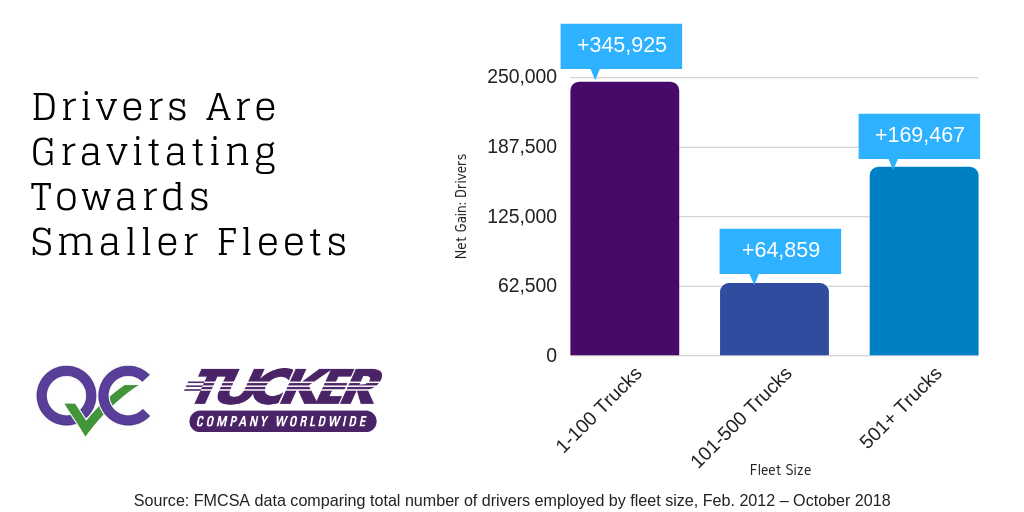
Drivers are gravitating towards smaller fleets

In the past six years, drivers have chosen to join smaller fleets or go in business for themselves as owner-operators. The 1-100 truck segment has grown over 42.9%, while fleets with 501+ trucks has grown 21.5%

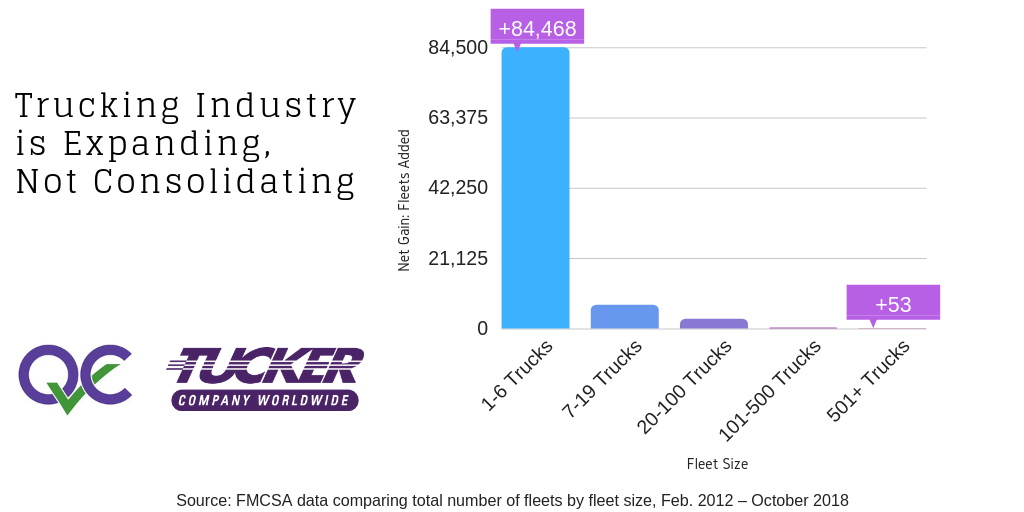
Trucking industry is expanding not consolidating

There are 84, 468more fleets in business with 1-6 trucks today than there were in 2012, while only 53 new large trucking enterprises have formed.

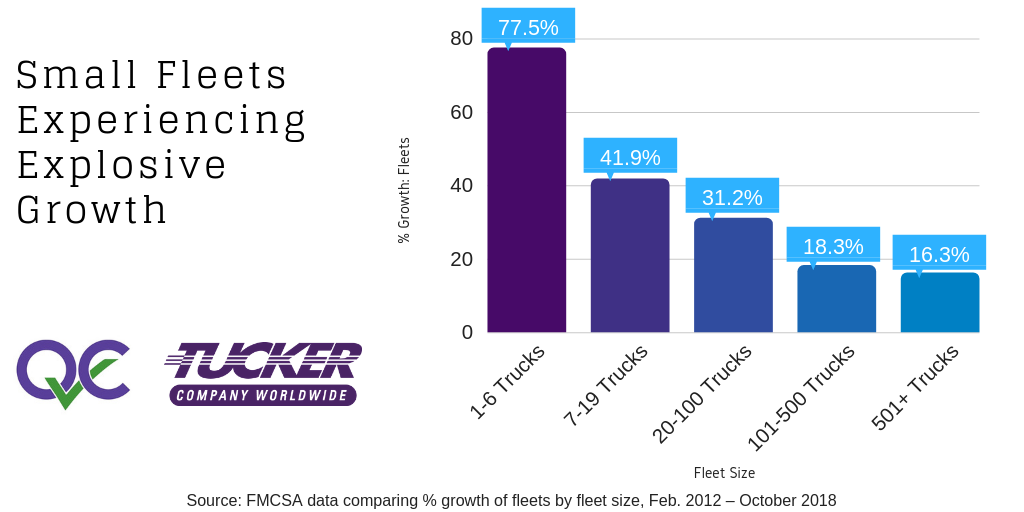
Small fleets experiencing explosive growth

In just six years, the smaller segments have grown rapidly, while the pace of the largest carrier fleets has hovered around 16%.

Want to dive deeper and learn more about our theories for these trends? Check out these blog posts:
https://tuckerco.com/driver-shortage-debunked/
https://tuckerco.com/shipper-buying-behavior-worsening-scarcity-of-specialized-drivers/

Categories
Uncategorized

Driver Shortage Debunked

Much has been made of the “driver shortage” gripping the nation. In reality, there’s not so much a shortage of qualified drivers as there is an inability of the large fleets that many shippers depend on to find more drivers.

Take a look at the numbers:
Since February 2012 –

  • Fleets with 501+ trucks have added 157,185 drivers– up 20%
  • Fleets with 1-19 trucks have added 224,886 drivers – up 54%

Many drivers are choosing to join smaller fleets, or strike out on their own. There are many reasons – more flexibility and control, better profit margins… but this is a problem for large shippers who aren’t able to reach this “sweet spot” where the drivers are more plentiful, but scattered. Who can? Brokers.

Invite your brokers into the fold, and tap into this rapidly growing fleet of trucking firms. These firms often have great drivers, who simply want to be treated as a person and work for an organization that knows his or her name. Brokers continue to invest in the tools, resources and practices to connect with these firms and add plentiful capacity, especially for larger shippers.

Categories
Articles Capacity capacity shortage ELD Electronic Logging Device Hours of Service Jeffrey Tucker transportation Tucker Company Worldwide

The Ripple Effect Of ELDs & A Forecast For The Future

Commentary: Jeff Tucker, CEO, Tucker Company Worldwide (tuckerco.com)

Life three months into ELDs has been thrilling, to say the least.  Full enforcement is just a week away, and when that happens, we’re likely to see a bigger effect in many areas. As a transportation broker we are in a unique position to evaluate the impact from both the carrier and shipper perspective. As the entire over-the-road marketplace struggles to make sense of current conditions, prepare for the future, and learn the new normal, here are some anecdotes we’ve compiled so far.

One of the most significant impacts of the ELD mandate has been the sticker shock of short hauls. Generally, drivers are paid by the mile, so it makes sense that drivers want to secure hauls that allow them to drive 400-500 miles per day, in order to make the best of their time on the road and the biggest paycheck. Before the mandate, drivers might have been willing to take a chance on a short regional move to keep moving. Under ELDs, they’re much more hesitant. Many carriers simply refuse short hauls.  So what can you  do if you have to ship short haul? Firstly, prepare to pay more. Secondly, your accuracy and your ability to turn the driver around so that he isn’t waiting at your dock, or your customer’s dock is paramount.  Running out of hours on a short haul guarantees the driver’s next load picks up late or is missed entirely, so the carrier may be unwilling to handle future loads.

As carriers upcharge shippers for shorter moves, the location of distribution centers becomes more important than ever. Most DCs were set up to reach the general population overnight, so budgets will be impacted, and will influence where future warehouses are located – and ultimately cause shippers to rethink the number of warehouses they utilize.

Parking is also at a premium.  Even with stricter adherence to hours of service, drivers are willing to stop well short of their maximum hours if they can secure safe parking and amenities at a truck stop. This further exacerbates the capacity situation.

ELD adoption is still an issue. According to the Bloomberg/Truckstop Quarterly Truckload Survey conducted by Truckstop.com and Bloomberg, 28% of truckers have yet to become compliant – to the tune of about 868,000 drivers. Trucks that are found not compliant after April 1st will literally remain stuck on the side of the road for a mandatory hours reset, and then allowed to proceed to its next stop, only. At that point, the truck may not move again until an ELD is installed!

Shipper uncertainty around 2018-2019 transportation budgets is high.  One auto manufacturer client we’ve spoken to saw its 2017 transportation spend at 500% of budget (give that a moment to sink in). General Mills’ stock tumbled this week, after revealing it exceeded its transportation budget. This will be the first of many corporations revealing such an impact.

Shippers who haul into major retailers also have compliance fees to worry about. Gone are the days of 3-day windows – many retailers have shifted to 1-day mandates. Shippers looking for flexibility in the supply chain have found that the demands of today’s market have made it more restrictive than ever, with compliance fees putting another significant hit on their bottom line. They’re also pushing LTL to partly empty truckloads, to ensure higher on-time percentages.

To make money matters worse, carriers are no longer tolerating long offload times, and are weeding out any locations that typically rack up detention charges – further limiting carrier options. Other carriers are assessing much higher accessorial charges to recoup time lost. Those charges ultimately get passed on to the shipper – resulting in yet another blow to the budget, and probably inflation down the line.

Shippers have also hurt themselves by using transportation as a stepping stone for staff. Fewer companies have seasoned transportation professionals in positions of leadership, leaving a significant void of institutional knowledge that’s gained from tenure. The sixth sense you need to be effective can really only be found with those on the ground, in the thick of it, listening to their brokers, carrier partners and drivers. An experienced transportation department can much more easily digest and react to changing market conditions. Plus, with their specific skill set, they can identify cost-saving measures and educate their organization on ways they can become a more attractive shipper to secure more capacity.

In regards to the bid process, we’re finally seeing the tide turn (again) from procurement handling bids, to transportation handling them, where it belongs.  Procurement teams are usually unfamiliar with transportation costs, and have treated lanes of freight as commodities, completely ignoring opportunities for round trips, continuous moves, drop trailers, and the value in long-term partnerships that have withstood the toughest of times. They won’t admit as much in mixed company, but every transportation department knows it to be true! In many cases, today’s enormous budget overruns are directly attributed to procurement practices, and not transportation.

We are still in uncharted waters as we wait to see what will happen once ELDs are enforced, but we think it’s safe to say that capacity challenges will continue for the rest of this year and well into 2019, as driver productivity is reduced and the market struggles to normalize. In the meantime, we’ll be keeping our ear to the ground to help make sense of these conditions for our shipper partners, and continue to focus on relationship-building with our stable of carriers and our committed customers.

Have questions or concerns? Contact jeff.tucker@tuckerco.com.