Categories
Uncategorized

State of Transportation: FMCSA Data Insights Oct 2018

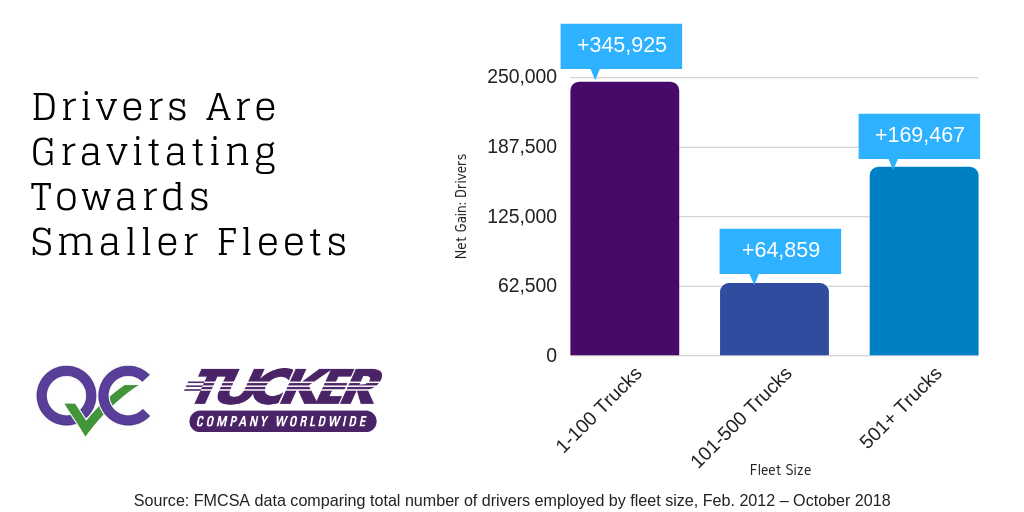
Each month, we analyze FMCSA census data to get a better understanding of how the freight market is performing. Here are a few key trends we have identified, comparing February 2012 data to the most recently released data as of publishing, October 2018.

Drivers are gravitating towards smaller fleets

In the past six years, drivers have chosen to join smaller fleets or go in business for themselves as owner-operators. The 1-100 truck segment has grown over 42.9%, while fleets with 501+ trucks has grown 21.5%

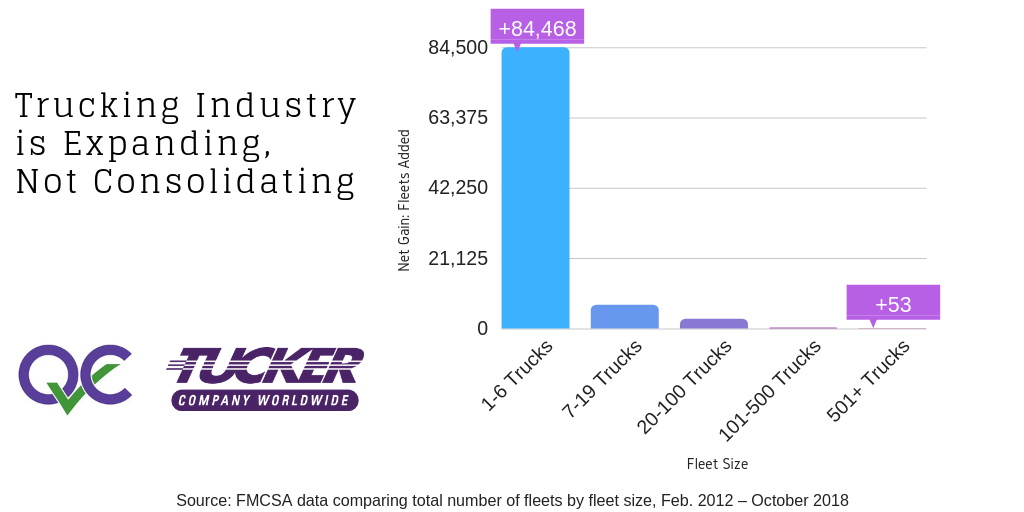
Trucking industry is expanding not consolidating

There are 84, 468more fleets in business with 1-6 trucks today than there were in 2012, while only 53 new large trucking enterprises have formed.

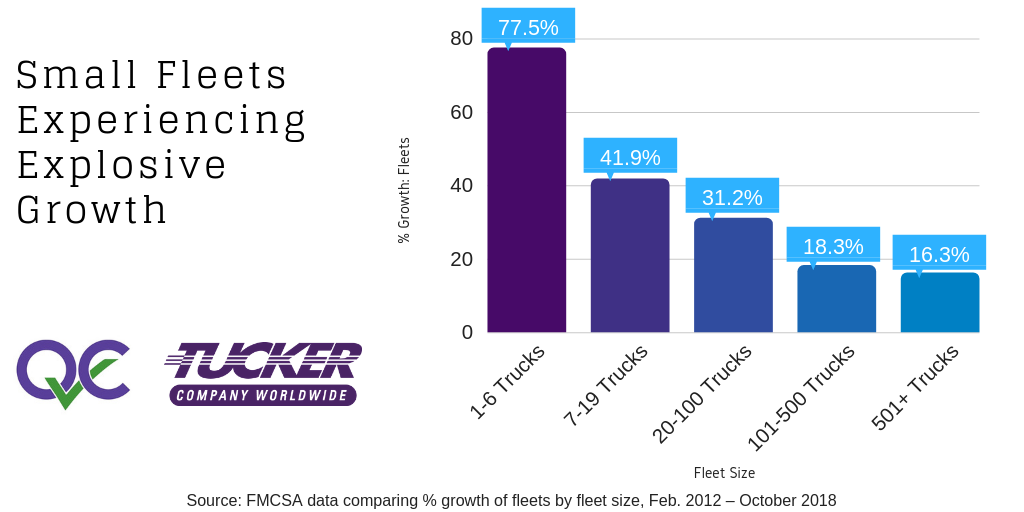
Small fleets experiencing explosive growth

In just six years, the smaller segments have grown rapidly, while the pace of the largest carrier fleets has hovered around 16%.

Want to dive deeper and learn more about our theories for these trends? Check out these blog posts:
https://tuckerco.com/driver-shortage-debunked/
https://tuckerco.com/shipper-buying-behavior-worsening-scarcity-of-specialized-drivers/

Categories
Uncategorized

Shipper Buying Behavior Worsening Scarcity of Specialized Drivers

By Jeff Tucker, CEO, Tucker Company Worldwide

When you look at the bigger picture of the trucking industry’s demographics, we don’t hesitate to argue that in the aggregate, a driver shortage doesn’t exist. Overall driver count is at an all-time record high, and the count continues to expand monthly. Look no further than this: since February 2012, there has been a net increase of over 551,000 drivers added to the “for-hire” fleets.

Higher driver wages, combined with better pricing data and cheaper, better operational software, coupled with the fact we are in the second longest economic recovery, is fueling better odds for success, and is, without a doubt, attracting drivers to the industry.  There is tremendous churn of drivers from one carrier to another. Data shown in “driver shortage” news coverage—trade media and popular media—doesn’t mention how the driver population has exploded especially since 2012. For example, in those 6 years, for-hire fleets with 1-100 trucks have added 332,000 net drivers, with fleets with 1-20 trucks accounting for 229,000 of that number. Overall, the nation’s driver count has increased by about 559,000 drivers, swelling the total number to 2.5M.

That doesn’t mean some areas of transportation aren’t in a crunch, especially if you’re hauling hazardous, liquid or dry bulk, oversized cargo, or even if you require a team. Every segment of trucking that requires additional training and skill sets is suffering a bit now. We see this in the oil and gas industry, for example – where there is activity supporting capital projects, new methane plants being built, and refineries upgrading. We don’t expect it to slow down anytime soon, especially since the US has recently become the world’s largest oil producer.

The explosive growth of drivers hasn’t percolated its way to the niche markets like compressed gas, liquid bulk, flatbed, specialized, hoppers, etc. Time will help, but a big factor that continues to delay progress is the struggle large shippers are facing as they reorganize the way they are buying freight. Their reaction to the new marketplace has caused an upheaval in the industry, and that’s in part because they have – up to this point – been using brokers as safety nets. When the core carriers fail, they bail to the broker. By then, the market is barren, creating a huge and very expensive spot market.

And this expansive spot market provides drivers with profitable, easy freight. Ask yourself, if drivers can easily find a tractor and a 53’ dry van or reefer, and not have to worry about hazmat, or tank/spill training, or having to climb 13.5’ off the ground to tarp a flatbed or a specialized piece of equipment, why on earth would they? If shippers reorganized efficiently, and put an end to procurement teams focused solely on price and transactions instead of supply chain efficiency, we would have more drivers available and motivated to take time to train and become more valuable, and get paid more.

Until then, those of you shipping specialty freight have to be willing to pay more – a lot more. Capitalism is at work in the marketplace. Driver wages have increased across the board. You’re competing for talent at the moment, and the big fleets are fighting with pay.

That’s not to say there aren’t other things you can do. If you have the privilege to speak with drivers as regularly as we do, you learn that it’s also about how drivers are treated. Be creative, and think of ways to make your enterprise more attractive to drivers. Have a driver lounge that’s nicer than your office. How about a small driver-only gym space?  Offer paid training (non-driving) time, to add more skill and pedigree for the drivers. Consider a salary-plus incentive plan.  Engage drivers. Recognize safety. Offer bonuses for “x” amount of miles without an accident. Celebrate service years. Large truckload carrier, Celadon, is reorganizing, and recently unveiled a granite monument this week at its headquarters, with names of 10+ year drivers etched into the stone! Celebrate drivers and make them love driving for you – and they will.

Categories
Uncategorized

Driver Shortage Debunked

Much has been made of the “driver shortage” gripping the nation. In reality, there’s not so much a shortage of qualified drivers as there is an inability of the large fleets that many shippers depend on to find more drivers.

Take a look at the numbers:
Since February 2012 –

  • Fleets with 501+ trucks have added 157,185 drivers– up 20%
  • Fleets with 1-19 trucks have added 224,886 drivers – up 54%

Many drivers are choosing to join smaller fleets, or strike out on their own. There are many reasons – more flexibility and control, better profit margins… but this is a problem for large shippers who aren’t able to reach this “sweet spot” where the drivers are more plentiful, but scattered. Who can? Brokers.

Invite your brokers into the fold, and tap into this rapidly growing fleet of trucking firms. These firms often have great drivers, who simply want to be treated as a person and work for an organization that knows his or her name. Brokers continue to invest in the tools, resources and practices to connect with these firms and add plentiful capacity, especially for larger shippers.

Categories
Uncategorized

THE 2017 CAPACITY CRISIS: Lessons from the Past, Advice for the Here & Now

Commentary: Jeff Tucker, CEO, Tucker Company Worldwide (tuckerco.com)
Trucks are harder to find and more expensive than ever before. We saw a glimpse of things to come during June and July of this year, but no one could be prepared for how September has progressed. Suddenly, rates that would once be considered ridiculous for the most straightforward lanes are to be expected. Options are limited: freight expeditors, who typically charge premiums over and above market price, are booked days in advance. Truckload carriers of any size, both temperature control and dry van, are equally hard to come by.  As a result, every carrier is prioritizing the customers it’s willing to serve, based on the return on investment. Case in point: one large shipper we know called a mandatory conference call for its primary carrier providers this month to discuss a large number of loads that were missed – and only a small handful of loyal providers attended the call!
 
Shippers are angry and frustrated, and we’re fielding calls from our customers asking whether things have settled down yet. The answer is a firm but disappointing “No.” The market for trucks is moving at light speed. As quickly as availability appears, it’s gone!
 
For those of us who have the benefit of tenure in this crazy business, market conditions are reminiscent of third quarter 2003, a crisis that didn’t let up until 2005. At that time, (2001-2) we were emerging from recession, and trucking was lackluster. Truck volume was up one quarter, down the next.  President George W. Bush and Congress passed a stimulus package in the 3rd quarter of 2003, giving rise to an 8.2% GDP for that quarter.  That remarkable and historic increase in spending, coinciding with peak 3rd quarter shipping overwhelmed the trucking industry overnight.  Shippers went from operating on autopilot, to vigorously competing with each other for trucks. Core providers disappeared. With capacity at crisis levels, January 2004 saw new hours of service (HOS) requirements, reducing the number of hours drivers could drive. As a result, capacity decreased again, at 3-4% at the worst possible moment. Truckload freight flooded LTL carriers and trains. Train speed suffered, forcing some freight back to truck. Capacity was impacted for about a year and a halfbefore the market caught up.
 
The current conditions feel similar, with different variables. I’d argue that we’re looking at a worse situation, and I’ll explain why. Trucking isn’t nearly as loose as it was in 2003. We’ve experienced a sort of equilibrium between supply and demand in the market for the last several years, which makes us more susceptible to disruption.  A snowstorm in the West upends the nation’s supply chain for days- sometimes weeks. Today’s massive hurricanes in the Caribbean, in Texas and Florida have had a more adverse effect on the market than the Bush 2003 tax credit. Plus, we’re on the cusp of peak 3rdquarter shipping once again, in the midst of a current capacity crisis, and to make matters worse – the ELD mandate is upon us.
 
Conservative estimates place the loss of hours, or productivity, that the marketplace will experience as a result of the ELD mandate at 3%-7%. That’s equal to, or more than, what we lost in 2004. And we had more supply in 2004. We’ve been warning our customers for two years about the ELD mandate, but we couldn’t have foreseen the impact of the recent hurricane season to disrupt the market even sooner.
 

There’s currently no end in sight, but there are a few recommendations I would implore shippers to consider. You’ll need to be limber in order to keep your business moving, as it’s going to be more competitive than ever. To start, I recommend reexamining budgets throughout your organization, from procurement, to finance, to planning, to customer service, your production facilities, vendors, customers, and please don’t forget about any distribution centers owned or leased. Trust me, you’re not the only company doing this, and some wise organizations are ahead of the curve. Second, your ability to be flexible will be your key to beating out the competition for capacity. Provide as much advance notice as possible, and keep your options open. You may have to push out pickup one day or more – but now is not the time to dismiss availability if you’re lucky enough to find it. The trucking market is as alive as the stock market. It’s far more stable and predictable, but it moves up and down, and nobody—not the largest shippers, the largest carriers, and the largest 3PLs combined, control it. It does what it wants. If you’re able to budget accordingly, incorporate flexibility, and strengthen partnerships with your loyal carrier and broker friends, you’ll be able to weather this crisis, while beating your competitors to the trucks and to the shelves.


Rest assured that Tucker is supporting you. Our management team led our customers through the first major crisis in 2003-5, and has been working internally for two years to prepare for 2017-2018. Contact jeff.tucker@tuckerco.com with any questions or concerns.

Categories
Uncategorized

Need Capacity? No Problem. Seriously. Give Us A Call.


What makes Tucker different? We may be the only freight broker in America who doesn’t use owner operators directly. We only use small, mid and large sized fleets. Most of the big guys have made it their mission to be among the best assemblers and marketplaces for owner operators to bid on posted loads. Nothing against owner operators, but Tucker’s business plan provides for long term sustainability, relationship building and leveraging, and for providing waves of extremely reliable capacity. 
If you’re dealing with a broker, or looking to add brokers or carriers to your mix, you are probably harming your chances to add capacity with every phone call or RFP you make.  To that you might say, “But Tucker, that doesn’t make any sense.”   Let’s see …
Adding another broker (that isn’t Tucker) keeps you churning in owner operator pools. You might get some loads covered, but you’ll likely never see that driver. You might get a lot of loads dropped for better pay. That’s not capacity. It’s not sustained. It’s not necessarily safe.  Chances are the driver demanded a cash advance from the broker. It’s not a foundation. It’s a bandage, at best.  
In stark contrast, Tucker deals only with fleets — small, medium and large. Our carriers are seeking long-term solutions to their imbalances, and work closely with our team to solve both your issues and theirs. They value Tucker, our reputation, and our customers. They bend, borrow and contort to ramp up capacity for us. When they’re primary on a lane, they’re like clockwork. When they sense they can move from backup to primary, they’re motivated.
Need help navigating a capacity crisis? Contact us today!
Categories
Uncategorized

Bad News for Small Fleets May Help Larger Fleets

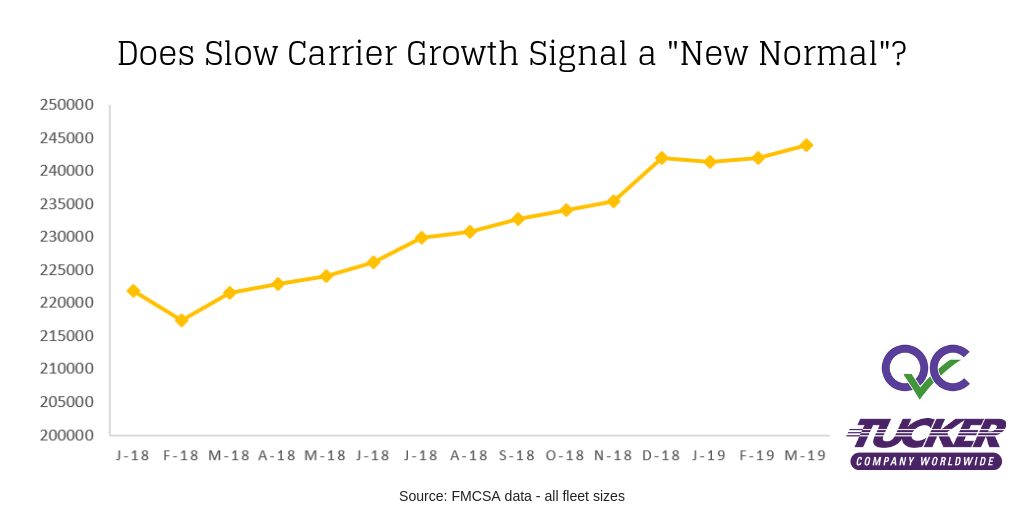
Does slow carrier growth signal a new normal?

Small fleets (1-6 trucks) are the backbone of trucking. They keep the market balanced, competitive and nimble and they represent the majority of the spot market volume. Many small fleets exist without shipper customers—simply using load boards to find the next load.

January represented either a blip or the beginning of tougher times. The nation lost 684 carriers from 1-6 trucks, from a fleet size of 201,539 in December. A small, but meaningful decline. It represented the first decline in 11 months, but the 17th monthly decline since March 2011. Considering the spot market has softened in the past few months, it has us wondering if we’re seeing a balance or a trend reversal.

Before we get too far ahead of ourselves, despite a drop, January’s numbers were the second largest number of active for-hire motor carriers ever recorded, 241,422.

Focusing again on the fleets with 1-6 trucks, January represented the second largest number of active for-hire carriers ever recorded, with fleet sizes 1-6, even after a big January loss of 684 carriers. February saw a rebound of 294 carriers.
Looking at the driver data for that segment is interesting too. Since 2012, fleets with 1-100 trucks added far more drivers than the largest (501+) truck fleets. In fact, fleets from 1-100 trucks added more than double the number of drivers than the biggest carriers, despite the pay raises and bonuses.

Most of that growth came from the 1-6 truck fleets. January’s data marked a significant decline in the number of drivers for the 1-6 truck fleets, falling by 5,457. February followed with a much smaller 187 decline in drivers for that segment. While small 187 is a small decline, it’s only the first time since 2012, there has been a decline over two consecutive months. Overall, across fleet sizes of 7-19, 20-100, 101-500 and 501+, the net overall gain in drivers in January was 12,988, and in February was 5,918, so we’re still adding real capacity. It’s just coming from different size fleets.

It’s too early to tell if we’re seeing a blip, a small correction, or the beginning of a significant correction and rebalancing of the marketplace. We’re coming into peak season, when produce begins to stir up the spot markets again. If history’s any lesson, a prolonged downturn, or leveling off of spot activity will begin to fill those long-empty seats in the larger fleets’ tractors, as drivers seek steadier income—until the next time.

We must be careful not to discount the new transportation economy. It’s quite different than anything we’ve known. Transportation has taken on new vigor and importance in our consumer economy which demands everything tomorrow, and wants zero inventory. For all the talk of technology and disruptors, it’s the small fleets who are showing strength, staying power and disrupting the plans of the big carrier executives. Smaller fleets are armed with innovative and rapidly evolving tech tools from the major load boards and their broker friends, who are helping them profit in ways they never could in the past. The historic rush of owner-operators “seeking some shelter with the big carriers” may not be as pronounced during the next downturn. It’s anyone’s guess how a market correction shakes out. It’ll be an interesting ride.