Categories
Blog transportation industry Tucker Company Worldwide

Choosing The Right Logistics Partner: Why Using a Broker Makes Sense

In the landscape of logistics management, businesses often face a pivotal choice between using an asset-based carrier or utilizing the services of a third-party freight transportation service.

Both options are generally the best choice, but it’s important to use a reliable third-party logistics (3PL) provider strategically and effectively, which is often not well understood. Strategic use of a 3PL can offer significant advantages, especially for businesses looking for flexibility, efficiency, and strategic insights in their supply chain operations. What’s more, using a 3PL strategically can help you prevent or reduce major budget overruns during the capacity crises that occur approximately every other year.

Understanding Brokerage Services

A broker acts as a liaison between shippers and a diverse network of carriers, offering a wide array of transportation solutions tailored to specific shipping needs. Unlike asset-based carriers that operate their own fleets, brokers leverage their industry expertise and network connections to match businesses with the most suitable carriers and transportation modes.

Benefits of Using a Broker

  1. Flexibility and Adaptability: Brokers excel in providing flexible logistics solutions that can quickly adapt to fluctuating market demands, seasonal variations, or sudden changes in shipping requirements. This agility is invaluable for businesses navigating dynamic supply chain landscapes.
  1. Access to Extensive Carrier Networks: By tapping into a vast network of carriers, brokers can offer a broader range of service options, ensuring that businesses find the most cost-effective and efficient transportation solutions for their shipments.
  1. Expertise and Industry Knowledge: Brokers bring deep industry knowledge and market insights to the table. They stay abreast of industry trends, regulatory changes, and optimal routing strategies, empowering businesses to make informed decisions that optimize their logistics operations.
  1. Time and Resource Efficiency: Partnering with a broker alleviates the logistical burden on businesses, allowing them to focus resources on core competencies and strategic initiatives. Brokers handle the complexities of logistics coordination, including carrier negotiations, shipment tracking, and compliance management.
  1. Risk Management and Insurance Coverage: Brokers often provide comprehensive insurance coverage and ensure compliance with regulatory requirements, mitigating risks associated with shipping and offering peace of mind to businesses concerned about liability during transit.
  1. Insuring Against Capacity Crises: It’s important to have a good mix of asset-based carriers and brokers in your network to protect against price increases. Currently, there are more small carriers than large carriers for the first time in modern history. Relying too much on asset-based carriers during a slow market can cause budget issues when capacity becomes limited. It’s crucial to evaluate both asset-based and non-asset-based providers equally based on their performance and pricing. This ensures that both small and large carriers are available when the market improves. Small carriers tend to be loyal and willing to take on more work when large carriers start turning down offers. This helps you avoid having to rely on the expensive spot market too often.

Not all brokers are identical. Just as you wouldn’t go to a brain surgeon for a knee injury, it’s important to consider the broker’s specialties and the carriers they work with to ensure that their services align with your needs. It’s important to evaluate: 

  • Operational Flexibility: Assess how well a broker can accommodate varying shipment volumes, destinations, and delivery timelines to meet specific operational requirements. 
  • Cost Efficiency: Compare the total cost of logistics, including transportation rates, additional service fees, and potential savings through optimized routing and carrier selection. 
  • Service Quality and Reliability: Look for a broker with a proven track record of delivering consistent service quality, reliability in meeting deadlines, and responsive customer support. 
  • Strategic Alignment: Choose a broker that aligns with your business objectives and long-term logistics strategy, offering scalability and support for growth initiatives. The brokers who say “we do it all” are often generalists, who may not align with your strategic needs. who aligns with your business objectives and long-term logistics strategy, offering scalability and support for growth initiatives. Brokers who say “we do it all” are often generalists.
  • Beware the Owner Operator Based Brokers: The brokerage industry relies heavily on owner operators (individual drivers with their own trucks) to transport freight. These operators play a crucial role in the supply chain, particularly for moving lower-end products, raw materials, and perishable foods. However, if your freight necessitates special services, timeliness, care, technology, and training, it’s advisable to work with a broker that partners with medium-sized and larger motor carriers who can offer these resources. These brokers have more advanced service capabilities compared to generalists.&

In summary, asset-based carriers are a crucial part of most large shipping operations. However, the changing marketplace and the five capacity crises in recent years have highlighted the essential advantages offered by brokerage services. By strategically partnering with a reputable specialist broker, businesses can leverage expertise, flexibility, and efficiency to optimize their supply chain operations, reduce costs, and enhance overall competitiveness. Embracing the strategic advantages of brokerage services can enable businesses to navigate complexities and achieve sustained success in their logistics endeavors.

Want to learn more about Tucker’s specialized services? Contact us today!

Categories
Blog transportation industry Tucker Company Worldwide

Carbon NetZero Offers Innovative Solution Amidst Ongoing Debate on Emissions Standards

Significant political and economic debate continues regarding greenhouse gas emissions standards for heavy-duty vehicles in the United States. Among the debates are the proposed greenhouse gas emissions standards set by the Environmental Protection Agency (EPA). These standards aim to curb emissions from heavy-duty vehicles, which are substantial contributors to air pollution and greenhouse gas emissions in the transportation sector. While industry and lawmakers debate whether these measures are essential or if they are causing an unfair burden to the trucking industry, companies need a way to reach their sustainability goals now.  

Introducing Carbon NetZero

Tucker’s Carbon NetZero programs was designed as a comprehensive approach to tackling Scope 3 emissions. This program is unique because we’re addressing Scope 3 emissions that focus on upstream and downstream transportation and distribution. Few transportation and supply chain companies know how to reclaim Greenhouse Gas (GHG) and CO₂ emissions, and even fewer have sustainable partnerships to give their clients confidence. 
 
Our partnerships are with Non-Governmental Organizations (NGOs) that have a long history of reversing deforestation and, therefore, pulling millions of metric tons of carbon dioxide out of the atmosphere. 

The reality of electric and alternative fuel vehicles is that they are coming, but we may be years away from this technology being efficient and affordable enough to be a viable substitute for many shipments. Mode conversion, when done right, is effective in reducing emissions, but those effects are a one-time benefit.  

The most natural, long reaching, and immediate impact on a shipper’s carbon footprint can be found through reforestation. Tucker can calculate the approximate CO2 emissions of your shipments and, through our partners, replant the Amazon to offset a percentage. 

Benefits of Becoming a Carbon NetZero Partner 

There are several compelling reasons for businesses to join our Carbon NetZero program

  1. Environmental Impact: By participating, companies actively contribute to carbon sequestration through reforestation efforts, directly offsetting their carbon footprint. 
  1. Credibility and Assurance: Tucker Company’s partnerships with established NGOs ensure transparent and effective carbon reduction strategies, giving partners peace of mind in their sustainability initiatives. 
  1. Recognition: Partners who commit to reclaiming 100% of their CO₂ emissions earn a Carbon NetZero badge. This badge not only signifies environmental leadership but also allows partners to showcase their commitment to their marketing materials, enhancing brand reputation. 
  1. Strategic Collaboration: Tucker Company goes beyond being a transportation provider; we become strategic sustainability partners. We assist partners in integrating sustainable practices into their business models, supporting long-term growth and resilience. 

The debate of how to handle sustainability in road freight is not likely to end any time soon. For more information on how to become a Carbon NetZero partner and embark on your sustainability journey, visit our sustainability page or contact us directly at sustainability@tuckerco.com.  

Together, we can drive meaningful change and build a more resilient planet for future generations. 

Categories
Blog transportation industry Tucker Company Worldwide

Streamline Your Logistics Activities with our Customer Portal

Staying on top of your logistics activities is crucial for efficient operations and meeting the demands of your customers. That’s why we are excited to introduce our Customer Portal – designed to streamline the management of your shipments and your account with us.

Real-Time Information at Your Fingertips

Gone are the days of waiting for shipment updates or making phone calls to track deliveries. With the Customer Portal, you have access to real-time information right at your fingertips. Whether you’re tracking shipment status, checking its current location on a map, or verifying delivery, you’ll always be in the know.

Take Control of Your Documents

Managing your documents has never been easier. Our Customer Portal empowers you to take control of your P.O.Ds, BoLs, invoices and more. Want to retrieve a Proof of Delivery for a specific shipment? It’s just a click away. Need to print an invoice for your records? No problem. Plus, you can monitor your balance and available credit with ease, giving you full visibility into your financial transactions.

Simplified Quoting

Tired of digging through e-mails to find your quotes? Our Customer Portal simplifies the quote process by storing your requests, the quote details and the rates all in one place.

Integrated Dashboard for Decision-Making

With a Customer Portal Account, you’ll have access to an integrated dashboard that provides a comprehensive overview of your shipments and account activity. From tracking your shipments to reviewing your accounting activity, you’ll have all the key information you need to make informed decisions.

Experience the Difference Today

Ready to take your logistics experience to the next level? Sign up for a Customer Portal account or request a demo today so you can see for yourself the convenience and efficiency it has to offer. With real-time information, streamlined document management, simplified quoting, and an integrated dashboard for decision-making, our Customer Portal puts you in control of your logistics operations.

image explaining benefits of Tucker Company Worldwide's Customer Portal

Contact us today to schedule your free demo.

Categories
Blog transportation industry Tucker Company Worldwide

Sustainability and the State of the Trucking Industry

A recap of Tucker’s 25-minute insight on significant trends and updates in the trucking industry today, with an emphasis on sustainability and regulatory shifts impacting YOUR business.

During a recent webinar on May 2nd, Jeff Tucker, CEO of Tucker Company Worldwide shed light on key updates within the trucking sector, pinpointing changes in capacity and logistics trends. He provided an overview of current regulations affecting both carriers and shippers, particularly addressing challenges posed by the latest EPA emissions rule. Jeff also introduced the Carbon NetZero initiative, unveiling actionable and verifiable solutions that support our sustainable commitments.

For anyone unable to attend, we’ve made the session available for you to view. Watch the full Sustainability and the State of the Trucking Industry.


Transcription: “It is 12:01 EST. So, my name is Jeff Tucker, CEO of Tucker Company, the oldest privately held trade brokerage in the U.S. And we have these webinars every other month or so. And I’m gonna ask right at the outset if there is anything that you would like to hear about, anything you’d like to learn about, anything that you would like to, you know, hear from an expert on, whether we are the experts or we find someone who is the expert, we’re interested in your thoughts. We’ve got a lot of friends out there in the industry and can help us, you know, bring up almost anything that you’d wanna learn about. So please, throw it into the webinar chat, and we’ll take notes and try to get that set up for you.

So gonna move on to the beginning here. Just a little bit of background. Several of us, including myself, have just returned from a whirlwind amount of trade show and association activity. This is just the sum of those that we have been to in the last several weeks. We’re very involved in the industry. It’s always been our mission to be involved in the 3PL group, which is the TIA, various shipper groups, to understand that…the issues that the shippers and our customers, right, are going through, and then the Truckload Carrier Association and some other carrier associations there to understand what our carrier partners are going through.

So, in order to be effective in that middle space where we exist, it’s really important…it’s always been terribly important since we were started in 1961 to really familiarize ourselves with and build strong relationships and bonds with. So that’s a little bit of our background. Couple things that are top of mind. I wanted to sort of share with you, there’s been a lot of talk of nuclear verdicts and insurance and the risk associated with those to shippers, to brokers, and even to carriers. Safety fitness determination is the future safety rating of motor carriers. Well, it was supposed to be out, like, in around 2010, and here it is, 2024, 14 years later, almost a decade and a half. And we are still waiting for the Federal Motor Care Safety Administration to get that program going and off the ground.

So right now, today, 90% of all carriers are unrated. That’s not necessarily a bad thing, but it’s certainly vague. And in science and in business, we don’t like vague. In risk management, we don’t like vague. FMCSA gets focused on a lot of different things that aren’t safety. And right now, they’re focused on a lot of things that are not safety, and unfortunately, we all suffer in between.

Fraud, I think a number of you put out… I was fortunate enough to testify before the House of Representatives in the U.S. Congress, the Transportation Infrastructure Committee, on fraud. Fraud is rampant in the industry, and, you know, it’s not one type of fraud, it’s all types of fraud. Bad actors that are masquerading as motor carriers, as brokers, and even as shippers, believe it or not. We’re even seeing today MC numbers for motor carriers being traded on eBay, right? So, that is not a good sign for safety, for security of your freight, and, you know, it’s something that a couple different trade associations we’re part of, are getting involved with. In fact, I think I’m gonna be on a telephone call with FMCSA’s, leadership and a couple of our trade associations in a couple of weeks to talk a little bit about that.

Fortunately, FMCSA is listening a little bit and taking baby steps in that right direction. So, they have a fraud task force that they’re gonna be putting together. We’ll have more on that as information develops. To the market. In the market, we’re still at relatively lowest tender rejection, you know, since Sonar began measuring this a few years ago, about 3.5%. So that means over 95% of the first carrier, first provider in line in TMS, is receiving or handling that load. And at the worst of pandemics, we’re at, like, 32% of rejection. So, you can see the flip has been big in that time.

Couple really kinda big pieces of news, I think. The ISM index is over 50 for the first time, which would indicate an expansion, not first time in a year and a half, an expansion in manufacturing. Good news for trucking, right? But at the same time, we’re seeing the inflation numbers not going down as quickly as we’d like. So little challenge there, and we’ll touch on that in the flatbed in particular market in just a moment.

The U.S. Department of Labor’s independent contractor law is a real threat to trucking, and I’ll touch on why in just a moment. You’ll see the data in just a moment. But the Department of Labor and I understand where the desire is coming from. The desire by the government is to protect these independent workers who really are employees, let’s say, of a company. So, they’ve advanced the line considerably where a contractor could be defined as an employee. Well, they did not carve out an exception in trucking. And in trucking, drivers do not want to be employees. They want to be owner-operators, okay? They want to work for themselves. They don’t wanna be forced into employment. And, unfortunately, the DOL, in its infinite wisdom, passed this rule and did not carve out trucking. So, that is a big risk for trucking, big risk for driver supply, but five lawsuits, and probably growing, are challenging that rule right now. So more to come. Something just to keep in mind.

And, lastly, and I will touch on this in a moment too, the federal government has offered, you know, $148 million in incentives for various ports around the country, some of the biggest ports, and then also in Puerto Rico to begin electrifying and cleaning the air around the ports, right? There’s a lot of idling there, and it’s one of the areas. That’s part of a much larger program, and we’ll get into that in a few moments. But I wanna just talk a little bit more about market. So, there’s a lot of charts, a lot of data. I’m gonna keep it really super simple and move on. The left chart is the one that we share most frequently, and that’s the Morgan Stanley Truckload Demand Index. And the little black line with the triangles is the average of the last several years’ demand for trucking. And it goes through seasons, you can see throughout the 12 months of the year.

Finally, right now, dry van, which is the largest segment in trucking, and trucking is not a monolith. Everyone says, “Oh, trucking is this, that, the other thing.” There are so many different marketplaces within trucking. These are three big segments, and then there are all kinds of little ecosystems beneath each one of those and more. But generally speaking, the van demand index is equal to now, what it has been over the last several years on an average. So, are we at equilibrium? Maybe. Maybe we are. Flatbed, I believe, reefers in the upper right-hand corner. You can see reefers still lagging, and there could be a number of reasons for that. I don’t have time to get into for right now. I’ve got a number of reasons for that. Also flatbed, you could see, is lagging considerably, I would imagine, and some of the analysts will point out that, hey, construction, because of high interest rates and housing, isn’t there. So, the flatbed market is off a little bit. So, there’s still probably a little bit of flex in the marketplace.

I wanna talk a lot about this for the next few couple of slides. So trucking industry, if you’re not already familiar with what’s happening in the trucking industry and what’s been happening for well over a decade, you have to be… In the event that you’re a buyer or that you’re an operator and you’ve got procurement buying for you, you absolutely positively have to know what is happening in the trucking industry. And the trucking industry is getting bigger, but the bigger carriers represent the smallest market share than…that they’ve ever had, you know, at least in the last 15 years or so. And that is continuing. That trend is continuing.

So, we’re at the smallest average, and this includes the largest carriers in the country, right? This number of 9.4 is where we are today. So, on average, there are 9.4 truck drivers in every trucking company. This is a chart showing two things. It shows the number of drivers in the marketplace, and the drivers are on the left-hand axis there. And the red line is a truck tonnage index as reported from the FRED in our Reserve Bank of St. Louis. They call it the FRED index. You can take a look there, believe it or not, through all those pandemic years from 2019, 2019 marks the highest freight tonnage mark. Remember, freight rates were through the roof, right? And supply chains were pretty messed up. It’s all scientific business terms. And people were stealing carriers from one, you know, supply chain to another and just driving up the price. And drivers were entering the marketplace to feed on that bonanza, on that frenzy. It was the worst capacity crisis in history by, like, half of the year over the 2018 one and some of the others before.

So, you know, we are only approaching the same freight levels of 2019, relatively speaking, and we have more drivers than in 2019. So, it’s my feeling that we still have more drivers than we need in this industry. And it’s also a fact, as far as I’m concerned, that there is not a driver shortage nor has there been a driver shortage. There’s driver shortage in liquid bulk and some real specialties because it takes a lot of time, effort, practice, and certifications that some folks just don’t wanna go through, right? And a lot more challenging. Imagine being on top of a flatbed that’s loaded, you know, nine feet high. You’re 13 feet up in the sky, and you’ve got a gift wrapped with a tarp in the middle of winter. Well, that’s a tough job, right?

So, you can see where some little pockets might have a shortage. There has not been a shortage. But the driver shortage is a narrative by certain Washington groups to get what they need out of Washington. But in reality, we’ve never met a day we weren’t able to move a load for the right price in 63 years of business. Driver and carrier counts are just off their all-time high. I’ve been talking a little bit about that driver count. This is the carrier counts. Carrier counts this time in the blue bar charts. You can see there we’re still above… Yeah, we are. We’re still well above 2019. So, a lot of carriers started. A lot of drivers and more carriers spun off from the big carriers during the bonanza, and not all of them have gone back to the big carriers, clearly.

This is a breakdown. This is from a market share standpoint, just in the last five years. So, it’s, like, the COVID years, right? So, from 2018 to today. And today is 2024, is the orange bar, and you could see that each of the carrier size segments. So, the largest carrier is 2501+ trucks is at the top, and you can see the smaller carriers at the bottom. The only group of carriers that added to their fleet size, excuse me, and added to their market share, excuse me, the only carriers adding their market share were the smallest carriers, the one to 100 truck size fleets. And I’ve said before in number of occasions, those fleets average about 5.3 trucks per operating company.

So, what does all this mean? Well, it means that if you’re not paying close attention, the capacity crisis for you as a shipper will be worse the next time than it was before. And the reason is because more than 50% of all drivers drive for the smallest fleets, well in excess of 70%, 75% of all drivers drive for fleets that you’ve never heard of before. Everyone has heard of the largest carriers. So, if you think you’re asset-based and you’re protected, and things are good now, things are good now because things are soft. You’ve gotta have a solid base of reliable, you know, third-party freight forwarders, brokers in there who can build assets, but smaller fleets and access these huge numbers of drivers, these huge numbers of reputable companies.

And another narrative that comes out of the Washington Trade Associations is that these drivers are unsafe. These drivers are on drugs. These drivers… That is not true. Keep it clean. That’s absolutely not true. That is what you say, again, when you’re trying to influence regulators and lawmakers. You’d have to prove that in order to make that truth.

Moving on to sustainability. It’s so funny, I’ve had a lot of talks in the last several months where I’ve indicated for 14 years, our company has been an EPA SmartWay provider. And we have not had a soul, not a single customer has cared. I think it’s…maybe they feel it’s a good thing. I’ll touch on SmartWay in just a second. But this year in particular, almost every RFP that we’ve received as a company has asked us, “Hey, vendor. What are you doing about sustainability?” They’re asking us to put down in writing what we’re doing, to give them advice, to give them places to look, and it’s a major fact-finding. We have some customers in certain industries who are asking us to help them on their journey at 10% a year, right?

So, just a few weeks ago, end of March, the editorial board of “The Wall Street Journal” excoriated the administration on their EPA’s EV mandate. And it was just at the time, we were having a couple different panel discussions on this topic and a couple different trade associations. So timing was good to touch on this. I’m not getting into politics. I’d never get into politics. I am talking about the industry and talking about data and facts.

The latest EPA guidance, you know, it’s aggressive, and there’s a Clean Freight Coalition that opposes, and it came out pretty loudly, kinda a few weeks ago, opposing these new rules, and, you know, for a good reason, right? I think that there’s recognizing that the challenges ahead are numerous, right? I think that anyone who thinks that electric trucks are, you know, in the next couple of years, it’s not reality. There’s about 55,000 electric vehicles predicted by the end of 2025. There’s, as you just saw, 3.4 million drivers driving, you know, in the for-hire fleet. So, it’s a hair on the elephant’s back, so to speak, in terms of what it’s gonna provide.

And what they’re currently concerned with, right, is the payloads. These batteries are extremely heavy. The payloads are gonna be reduced. In addition, where these vehicles are already in use at some ports around the country, you need two times as many trucks to move because the battery can only handle a certain number of turns before it’s out. So it can’t keep up with the amount of fuel that a diesel engine can keep up with. So, a lot of challenges. In addition, the cost for the infrastructure is, you know, around $600, $700 billion with a “B,” and that is the entire cost of all freight transportations over the course of a year. So, not small peanuts by any means.

So, the Clean Freight Coalition is a group of, primarily, industry associations. I think ATA and Truckload Carriers Association are two members, but there are many others. And to hear ATA, and we’ve heard the chair of ATA speak numerous times in the last several weeks, they’re really concerned about these rules. However, when you’re in a situation like us and many other companies who are being asked to find ways and doing nothing isn’t the option, what can you do? And realizing that, you know, these EVs or hydrogen, or whatever, this is way down the road. It’s coming. There’s something that’s coming. I don’t know what it is. Alternative vehicles are coming in some way, shape, or form, and at some point. But to answer the questions on our RFPs, to answer the questions that our customers have, and to help our customers on their path to reducing, the easiest button to push, the easiest lever to pull is mode conversion, right?

Air is the most polluting kind of freight, pound for pound. So, air to truck, air to ocean, that saves a lot, right? The challenge there, well, you’ve gotta have more product because there’s gonna be errors, you know, same day, next day. Ocean could be two weeks, right? So, you’ve gotta have more product, and you’ve gotta involve your CFO, clearly, and the whole organization to do that. But that’s the one that a lot of folks are pressing. That’s a lever you can pull just once, and that’s it. That gain is gained, and that’s it, right? You can’t do anything more with that, right?

I alluded to this earlier, you can use SmartWay partners. Again, we’ve been a SmartWay partner for 14 years. No one has ever asked us to quantify the savings. We’re ready, willing, and able to quantify those savings. If you’re doing business with SmartWay carriers, SmartWay providers, you’re more likely to have connectivity to emerging technology that is coming, when it does come.

I don’t have too much time to get into this. Scope 3 is really the emissions as a result of trucking and freight operations. So, if you’re a manufacturer, your scope 3 emissions come from folks like us who arrange your freight. That’s the simplest and shortest answer to that. Another lever that we can pull, right, in addition to using the SmartWay carriers and mode conversion, is to say, “Okay. We can remove a portion of the CO2 that we put up in the sky by alternative methods.” And there’s a lot of technology, a lot of companies out there using machinery to extract CO2. It’s gonna be very expensive, terribly expensive. And there’s a question as to how effective it’s gonna be and where you store it.

The most natural way is to reforest forests. In particular, we are focused on the Amazon. We’ve got an NGO relationship in South America where we’re reforesting the Amazon. On a 600-mile shipment, and that’s about the average truckload shipment in the U.S., a 600-mile shipment loaded with 40,000 pounds of freight throws off 2.2 metric tons, approximately, of CO2. That’s equivalent to the weight of an African elephant, elephant again. And, you know, that’s a lot. That’s a lot of CO2, even with today’s cleaner engines. So, one hectare, which is, like, 2.5 acres, one hectare of rainforest removes from the atmosphere about 400 metric tons of CO2. So, this is one more lever that we’re offering our customers. And it’s primarily over a 30-year period, but over the first 15 years was when most of that CO2 is removed. But we’ve already replanted almost two hectares today, just since the beginning of this year, and we’re offering this to our customers as well. So, it’s a relatively inexpensive, about 10.8 cents a mile at today’s land availability. That may change as more land becomes available.

Very quickly, these photos will show the Amazon Forest way out there in the distance, but what is happening is land is being taken for cattle. The lumber is taken away and sold. The cattle grazed for about 10 years. They waste the land away. Soybean farmers come in. They till the land. That’s that center bottom photo. That land is tilled ready for soybeans. The photo on the left is the soybeans. They run that land for another 8 or 10 years until it’s arid, it’s got nothing left. And then they do it, and they take more, and they take more. So, there’s an opportunity here to, you know, reforest, and it can happen very quickly. And the left picture is, like, one week’s worth. That was out of the right side of the truck. Out of the left side of the SUV was the second photo, and that’s 11 months of growth in the Amazon rainforest. And the right-hand photo, that’s me in the foreground, is a photo that shows about 10 years of growth in the Amazon.

So that’s how quickly this thing can take off. So, that is, in summary, you know, what we are here to talk about. I ran a little longer than normal, but had a lot of content to share. And it’s been a few months, probably, since we last spoke. So, happy to answer any questions, if we have any. See any questions, Tucker team. That said, we’re looking… Again, please encourage, you guys listening, if there are any ideas, any thoughts that you would like covered in the future, we know a lot of folks are happy to, you know, invite those folks, you know, to share their views, their thoughts, their areas of expertise.

Okay. See if there’s… Going once, going twice. I appreciate everyone’s attention here today and your attendance, and thank you guys. You know, the market is in that state of equilibrium. We do think, like most folks do, that, you know, probably toward the end of this year, we start to see a tightening. Where we are seeing tightening, I didn’t mention this, is in areas where performance matters. Our team will tell you that carriers are being a little bit more selective in terms of the lanes they’re accepting, whereas last year, this time, they don’t most accept anything. It’s a little bit more selective now, especially with the high-performing, you know, providers.

So, I think that’s the first thing we typically see when things begin turning around is that initial feeling of, “Hey. Yeah. No, that doesn’t work for my operations,” you know. It’s a good thing for our industry. I think it’s been a tough go for a lot of folks in the freight industry, and, you know, I think we’re getting back to normal. All right. Folks, thanks so much, and we’ll call it a day. Have a great day.”

Tucker’s Carbon NetZero

Tucker’s Carbon NetZero program empowers businesses to reduce their carbon footprint through a comprehensive approach. Our Sustainability team customizes plans to align with your strategic goals, offering options to reclaim 25-100% carbon emissions.

Tucker’s webinar is hosted every quarter with industry leaders for engaging discussions on topics that matter. Reach out to us with your ideas and questions.

Categories
Blog transportation industry Tucker Company Worldwide

The Persistent Challenge of Trucking Fraud in 2024

Despite advancements in technology and regulatory measures, in 2024 trucking fraud continues to present challenges that demand attention and innovative solutions. The Transportation Intermediaries Association (TIA) estimate a loss of $500 million to $700 million to fraud victims in the supply chain industry.

Trucking fraud is not new, but it has evolved. Despite advancements in security measures, 2024 sees trucking fraud encompassing falsified documents, cargo theft, identity theft, bad actors masquerading as motor carriers, as brokers and even as shippers, and in some cases, and sometimes digital systems manipulation. Fraudsters exploit the industry’s complexity, targeting various stakeholders and stages of transportation.

Recognizing the need for policy change, our CEO, Jeff Tucker, testified earlier this year before Congress’ Committee on Transportation & Infrastructure. As the only freight industry witness, he helped to shed light on the need for policy changes, aiming to revolutionize the freight industry for decades ahead.

His testimony requested that the Federal Motor Carrier Safety Administration (FMCSA) focus on fraud and critical safety issues. Using data, he sought to shatter the myth of a truck driver shortage, highlighting a surge of 1 million drivers in the past decade and calling for a more nuanced dialogue around drivers counts. He urged Congress to insist that states adopt one air quality standard, and not a patchwork of 50-plus, and urged expansion of the US-Mexico border capabilities.

What else can be done about fraud?

With or without policy change, a multi-pronged approach is necessary to combat fraud:

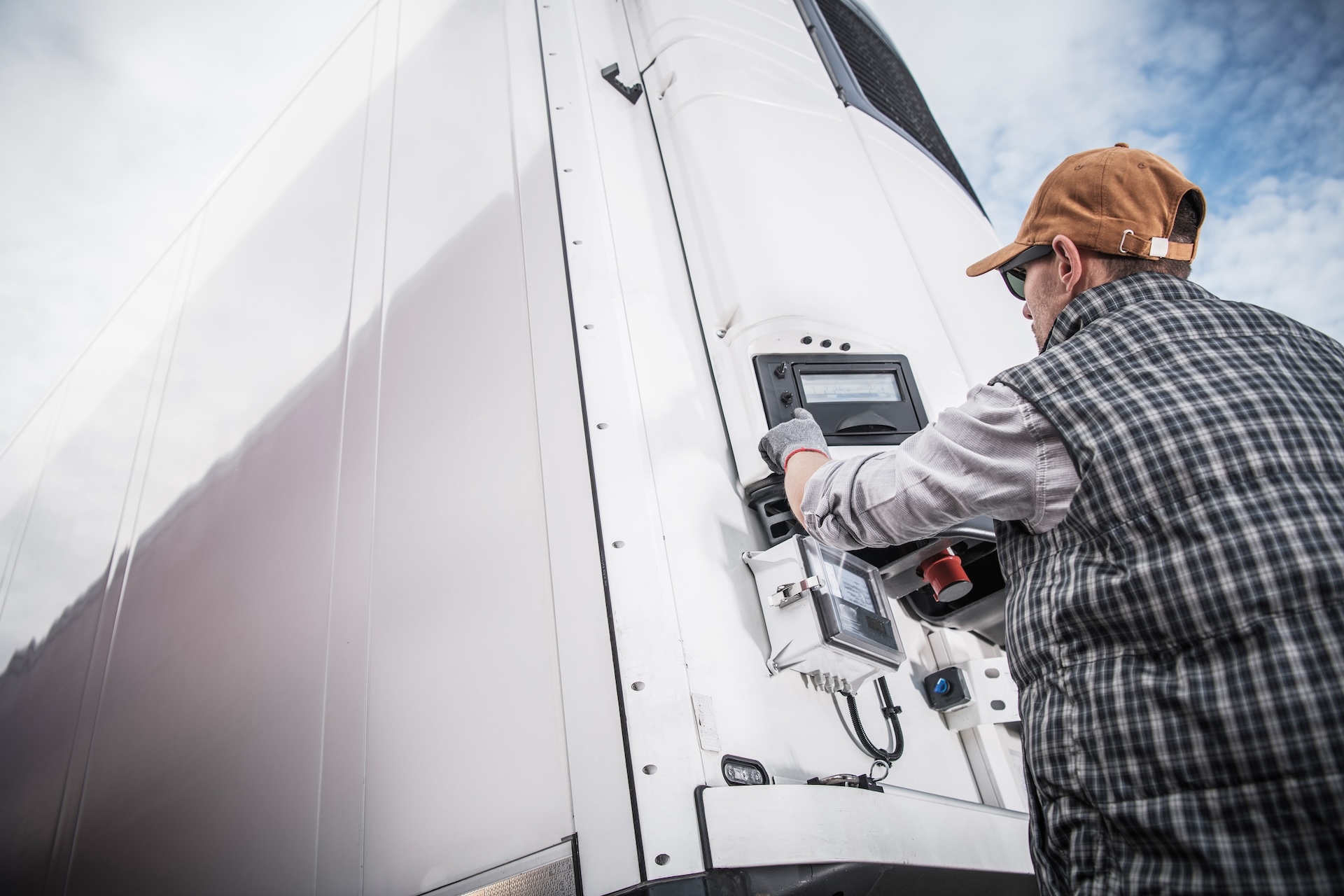
Refrigerated Semitrailer Cargo
Fraudsters use sophisticated methods to steal freight and hack into systems.
  • Embrace Technology: Blockchain offers a decentralized and immutable ledger system that enhances transparency and traceability across the supply chain. By leveraging blockchain technology, stakeholders can securely record and verify transactions, reducing the risk of fraudulent activities such as document tampering and cargo theft.
  • Strengthen Cybersecurity: As digitalization accelerates within the trucking industry, investing in robust cybersecurity infrastructure is imperative. Carriers, brokers, and logistics providers must implement advanced encryption protocols, multi-factor authentication, and intrusion detection systems to safeguard sensitive data and mitigate the risk of cyberattacks.
  • Collaborate: Combatting trucking fraud requires collaboration among government agencies, law enforcement authorities, industry associations, and technology providers. Sharing intelligence, best practices, and resources can strengthen defenses against fraudulent activities and facilitate swift response to emerging threats.
  • Educate: Building awareness among stakeholders about the various forms of trucking fraud and imparting training on fraud detection and prevention strategies are crucial steps in fostering a culture of vigilance within the industry. Equipping drivers, dispatchers, and administrative staff with the knowledge and skills to identify suspicious behavior can help thwart fraudulent attempts effectively.

Tucker’s Approach

At Tucker, we believe we can play a key role in the battle against trucking fraud. By continually focusing on the ongoing evolution and conversation around fraud, Tucker seeks to remain at the forefront of these preventative methods and to pass that knowledge onto our customers. As a company we focus on the following:

Man smiling next to tractor trailer
Tucker focuses on careful selection of carriers, enhanced security, and protecting the value of your shipment.
  • Company design: Tucker is intentionally engineered to operate differently from most brokers, since we deal mainly with motor carrier fleets, not the owner-operator. This design provides many values, including: knowing our carrier friends; obtaining commitments; providing us the ability to cover lanes, and not just transactionally cover loads; allowing us to invest in, and grow long-standing relationships with fleets and their operations and ownership, and providing a more steady, reliable service to our customers, to name a few.
  • Carrier Selection: Tucker leads the industry in carrier selection expertise. Our CEO previously chaired the committee that publishes the only trade association endorsed “Carrier Selection Framework.” We collaborate with the best minds in safety, security, and risk management within the industry to ensure we’re providing services and carriers who protect your cargo and your brand.
  • Forensic Dispatch: Once a carrier meets our meticulous expectations, our team doesn’t stop there. Our well-trained personnel continue to reinforce load requirements, verify SOCs, relay safety and security best practices, and evaluate timeliness to ensure Tucker arranges transportation when and where it is promised, each time.
  • Industry leadership and freight security: Tucker realizes how important it is to keep our finger on the pulse of our industry and yours to ensure we have a greater understanding of your goals and the requirements of handling your freight. Tucker is an active member of many industry safety groups including the Transportation and Logistics Steering Committee of BSMA, HPCLC’s Service Provider Council, Pharmaceutical Cargo Security Coalition (PCSC), Transportation Intermediaries Association (TIA) and more.

Moving Forward

In April of 2024, federal regulators announced that they are creating a team specifically to deal with trucking fraud. In response to years of complaints from truckers, brokers, and insurance companies, the FMCSA’s Registration Fraud team will focus on assisting victims of fraud and look for ways to prevent it. This new team is taking several immediate steps including tightening IT security to prevent scammers from breaking into their registration system.

In the landscape of global logistics, the battle against trucking fraud is ongoing. While technological innovations and collaborative initiatives offer promising avenues for combating fraudulent activities, the ever-evolving nature of fraud demands continuous adaptation from all stakeholders. By embracing innovation, fostering collaboration, and prioritizing vigilance, fraud risks can be mitigated to ensure supply chain integrity in 2024 and beyond.

Tucker Truck Image

Contact us today, and let’s discuss how Tucker can assist you with all your shipping needs.

Categories
Blog transportation industry Tucker Company Worldwide

Effects of the Baltimore Bridge Collapse on the Freight Industry

As you may be aware, in the early morning of March 26, a cargo ship lost power and crashed into the Francis Scott Key bridge, causing it to collapse into the Patapsco River. The incident has resulted in the temporary shutdown of one of the most prominent and heavily traveled hazardous materials routes in the Northeast corridor. The impacts of the Baltimore bridge collapse on the freight industry will be far-reaching.

Approximately 31,000 vehicles use this bridge each day and about a quarter of them are commercial trucks. Of the three alternate routes, only one is not prohibited from allowing the transport of natural and compressed gases. Trucks hauling hazardous materials will need to take the longest alternate route along the western section of I-695. Additionally, all vessel traffic into the Port of Baltimore has been suspended causing costly diversions of cargo ships. Experts are reporting that repairs could take up to two years.

While the Port of Baltimore is modest in size compared to other ports in the Northeast, customers should still anticipate potential delays. Regular volumes, shipments with tight timetables, and same-day and next-day shipments are most likely to be affected. Proactively seeking alternate schedules may help to mitigate the impact.

Despite widespread diversions and the shutdown of the port, logistics experts do not expect a major supply-chain crisis. We encourage customers to communicate openly with their providers to manage the changing routes and traffic routes caused by this tragedy.

Contact us today for guidance on diverting your freight.

Categories
Blog transportation industry Tucker Company Worldwide

Trucking Market Update: Lessons Learned in 2023 & Preparing for 2024

A recap of Tucker’s data-driven 30-minute analysis and Q&A regarding the trucking market’s past year and looking forward to the year ahead.

2023 was a challenging year for many in the trucking industry, but as with any difficult period, there are lessons learned and key takeaways that will help us prepare for the coming new year.  In a recent webinar held on December 14th, 2023, Jeff Tucker, CEO of Tucker Company Worldwide, shared insights into navigating the road ahead

If you missed the live session, don’t worry! Watch the recording below of the 12/14/23 Trucking Market Update with Jeff Tucker.

Categories
Blog transportation industry Tucker Company Worldwide

Shippers Searching for Capacity Should Award 50% or More of Their Lanes to Brokers

Amidst today’s highly cyclical truckload market, shippers are faced with the challenge of constructing robust transportation networks that can weather the storms of capacity crises. As the market’s volatility continues to rise, the need for shippers to strategically allocate their lanes becomes increasingly apparent. This is where the idea of shippers awarding 50% or more of their lanes to great brokers comes into play. This shift in strategy not only enhances scalability but also fosters resilience in the face of market fluctuations. 

The 50/50 Volume Standpoint 

In the realm of transportation, data is king, and balance is key. The prevailing wisdom has often leaned toward relying heavily on carriers (“asset-based providers”) to fulfill capacity needs. However, a shift has been occurring over the past decade, emphasizing the significance of balance between carriers and brokers. For the first time in modern history, over 50% of all drivers today drive for fleets who control on average 5 trucks! You simply cannot depend upon large carriers to support business in good times and bad. Understanding this data then, the magic formula lies in the 50/50 volume standpoint – a strategy that might seem unconventional but holds transformative potential. This balance ensures that the shipper leverages the strengths of both brokers and carriers, maximizing its flexible and adaptable transportation network.  

Seeing Beyond Low-Volume Lanes 

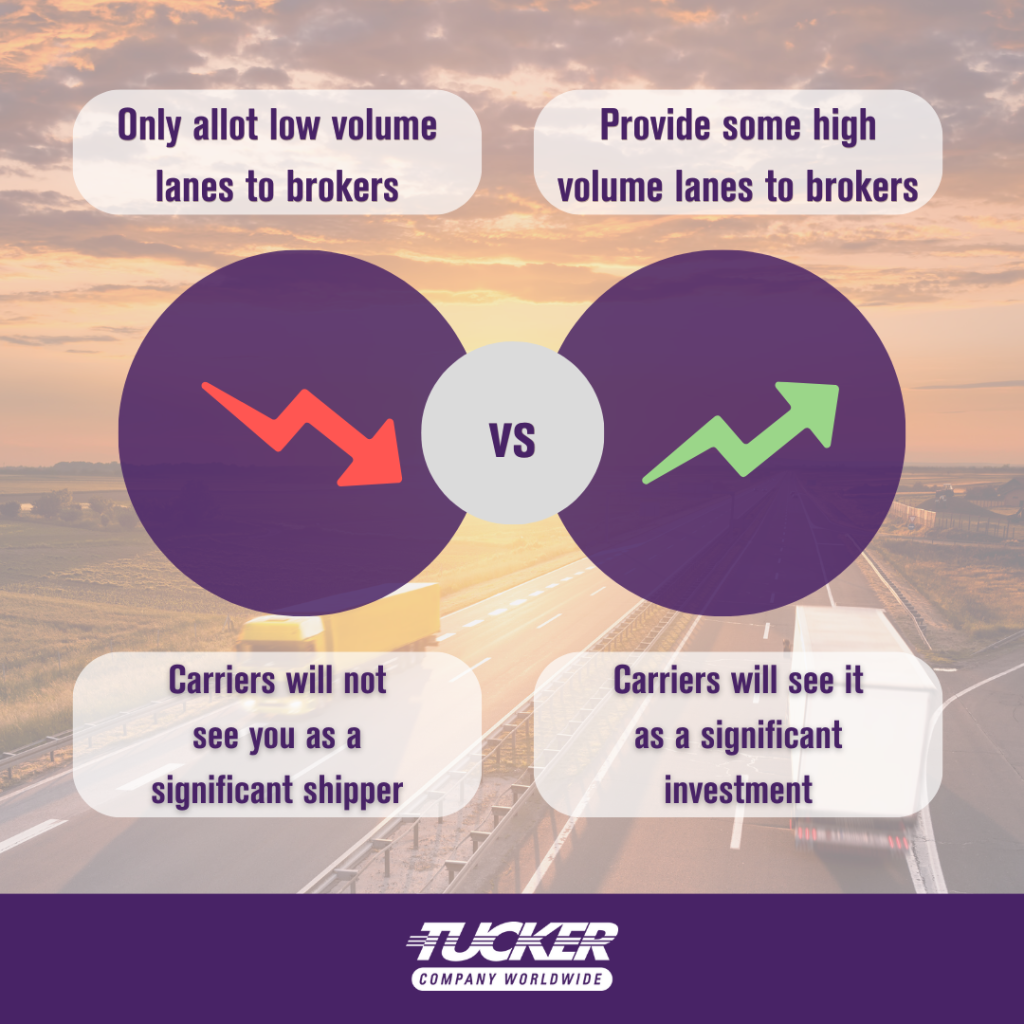
For shippers to truly capitalize on this approach, they must understand a crucial element: not just any 50% of lanes will suffice. It’s not about relegating low volume lanes to brokers; it’s about embracing a strategic blend. The goal is to empower brokers with substantial lanes, and here’s why: when the market shifts and the need for scalability arises, brokers armed with high-value lanes become integral. The carriers underwriting the broker lanes see the shipper as a critically important customer and will give added capacity to the shipper as soon as the large asset-based carriers begin rejecting tenders. Big carriers are rejecting loads sooner in market swings, and in higher percentages because (a) their biggest customers demand their attention as other carriers leave them struggling, and (b) large carriers begin offering more of their capacity to the spot market, where rates are higher, and returns are lush. With brokers ingrained into your volume, they and their smaller fleets can scale up more seamlessly as the big carriers begin their rejections. 

Creating Significance in the Eyes of Carriers 

Shippers who hesitate to award a sizable portion of their lanes to brokers will find themselves facing dwindling tender acceptance rates from carriers sooner in the next market swing, and paying spot prices to gain that needed capacity. If brokers are entrusted solely with low-volume lanes, then the carriers who are supporting that business only see low-volume, sporadic business and thus do not view the shipper as a significant investment. However, by awarding 50% of the volume to carriers and 50% or more to brokers, shippers establish themselves as key players, increasing the likelihood of their freight being prioritized. 

low volume versus high volume lanes to brokers

The concept of allocating 50% or more of lanes to brokers isn’t just about numerical distribution; it’s about perception. By entrusting brokers with high-value lanes, shippers convey that they consider brokers as valuable extensions of their logistics strategy. This shift in perspective can lead to increased investment from carriers and brokers alike, enhancing the overall efficiency of the transportation network.

Strategically Building Resilience 

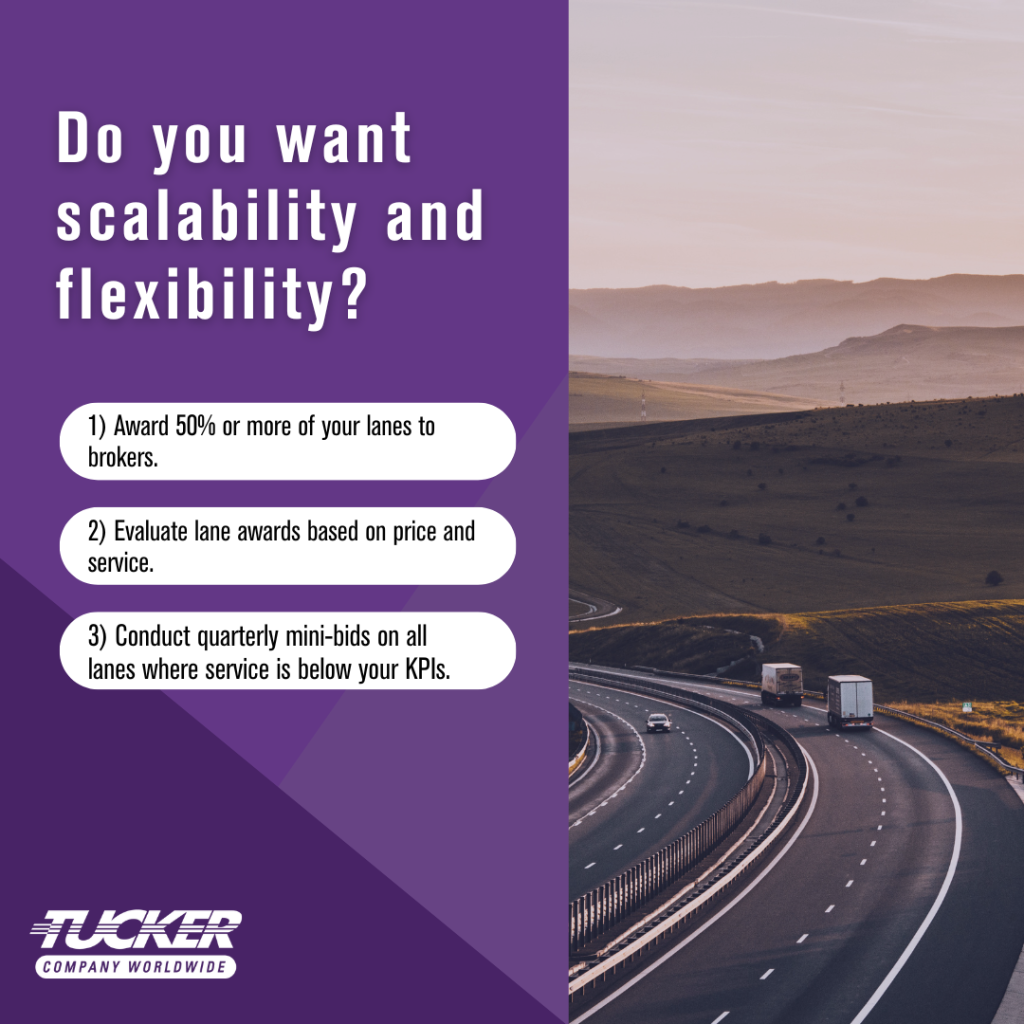
In a market that ebbs and flows, resilience is a shipper’s most potent weapon. The concept of awarding lanes based on both price and service is instrumental in fostering this resilience. Shippers should conduct quarterly mini-bids on all lanes where service falls below their Key Performance Indicators (KPIs). Following these steps will ensure shippers can navigate the cyclical nature of the market more effectively. 

do you want scalability and flexibility?

Navigating the Unpredictable  

In an era where the transportation landscape is characterized by its unpredictability, shippers must embrace innovation. Shippers who adopt a 50/50 volume allocation strategy position themselves to navigate these cycles more effectively. If you want scale and flexibility, the carriers your broker uses needs to feel the weight of you, the shipper, as its customer too. By recognizing brokers as partners who can contribute to scalability, flexibility, and resilience, shippers can forge a path to success, even in the face of market volatility. The time to act is now – to build a future-proof transportation strategy that will weather any storm. 

Contact us today, and let’s discuss how Tucker can assist you with all your shipping needs.