From weighing in on market trends to “playing it cool” with industry friends, we had a lot of fun this year! Check out what we were up to.



From weighing in on market trends to “playing it cool” with industry friends, we had a lot of fun this year! Check out what we were up to.

2018 was a wild ride. We experienced the implementation of ELDs, the introduction of strict compliance fees from retailers, and an influx of well-meaning but disconnected technology. Despite the market conditions (or as a result of them), the number of carriers continued to grow throughout 2018.
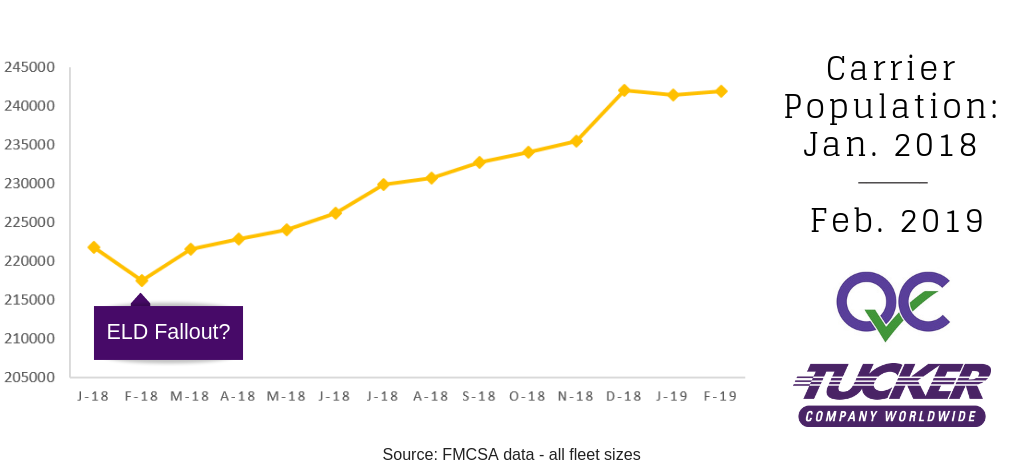
The data shows a dip right around February. If you remember, although ELDs went into effect in December, they were not fully enforced until April 1st. We suspect that the decline may reflect a number of carriers that decided to get out of the business rather than comply.
Regardless, as peak season reared its head, March saw a return to January’s numbers, and only increased from there. As the year went on, and the spot market increased, so did the number of carriers in operation.
To put it into perspective, 14,674 carriers entered the marketplace in 2018, versus 12,232 the year prior. In a year where headlines screamed consolidation, driver shortages, and carrier attrition due to the implementation of ELDs, a 20% increase in the carrier pool is certainly at odds with the popular narratives.
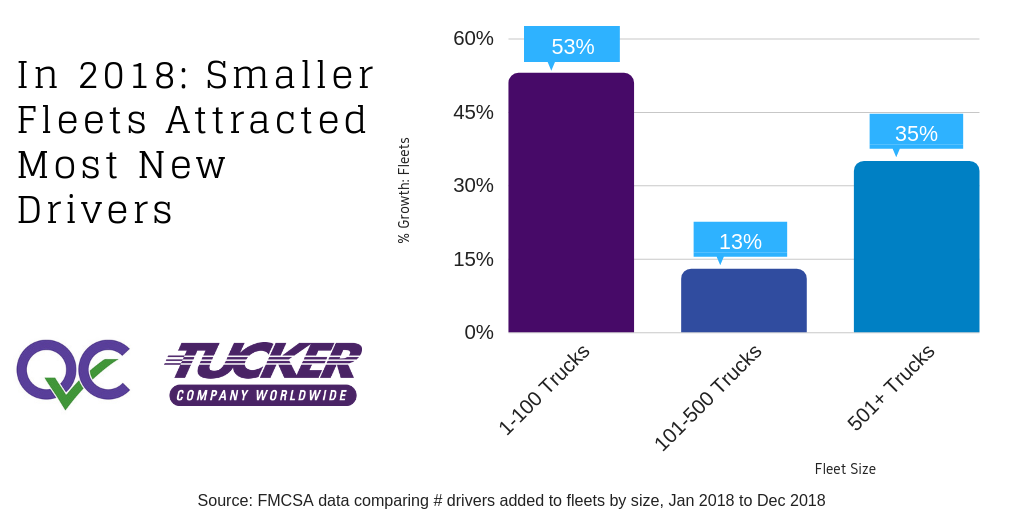
The freight industry also added over 107,000 drivers in 2018. Here’s a snapshot of where they filtered into the carrier pool:
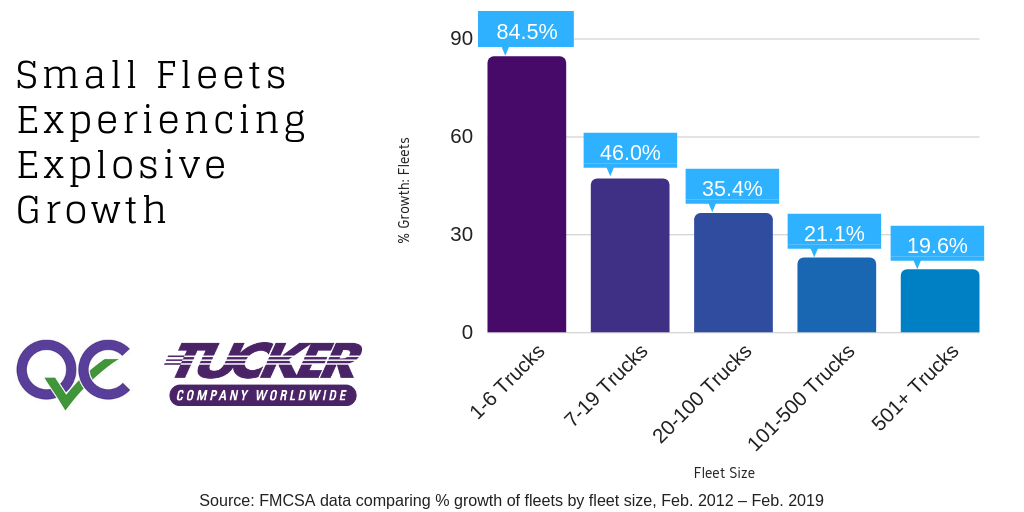
With January and February’s numbers incorporated, here’s an updated snapshot of how each fleet size has grown since 2012:
The first quarter of 2019 saw much less freight falling to the spot market, and the carrier population showed a small decline. Is this a blip on the radar, or is the carrier data signaling an inflection point? With more drivers striking out on their own last year, only time will tell if they can find enough freight to be successful. The technological tools that were introduced into the marketplace should certainly help them understand market trends, connect with shippers, and price effectively.
As a freight broker, we continue to monitor these trends in the freight market to better serve and educate our customers.
By: Jeff Tucker, CEO, Tucker Company Worldwide
Transportation in 2018 was a year of continued upheaval. To those of us who feel the trucking market is a living and breathing entity, it validated that, and we are beginning to be able to identify some of the predictable conditions that are recurring. We witnessed the ongoing migration of drivers joining smaller fleets or becoming owner-operators at a pace of more than 2-1 (100 trucks or less gained 366,311 drivers since 2012, while fleets with 501+ have only snagged 176,058). That trend has contributed to the biggest carriers’ inability to add capacity. Simultaneously, the biggest shippers’ strategy of using brokers only as a backup to their asset-based providers, in the so-called “waterfall” swelled the spot market to a peak this past summer. The results? High prices, late shipments, and blown budgets, to name a few. These market inefficiencies, combined with slow-to-react transportation buyers caused an abnormally large spot market which was a mirage, destined to fade.
So what are we seeing so far in 2019? Data from Truckstop.com, SONAR and DAT all point to a softening in the spot market during the last half of 2018, and the first quarter has felt pretty normal. There are many possible contributing factors. Has the market overcorrected, like markets often do? Did the addition of over 611,000 drivers to the for-hire fleets, bringing the number to over 2.5 million drivers, change the capacity equation? Has tariff uncertainty halted trade enough to let the steam out of the market? Wall Street’s feeling the uncertainty – we saw all of 2018’s gains reversed by Thanksgiving, with experts citing concern for global and U.S. growth, led by tech declines. Any one of these factors is enough to prick the capacity shortage bubble, and restore pricing power, at least temporarily, to buyers.
What is certain is that the industry is evolving faster than it ever has before. Exorbitant (and often foolish) investment in transportation technology and startups is spurring new ideas, which are often “borrowed” as quickly as they’re learned and incorporated into existing businesses and software. “Digitalized” freight is the latest buzz phrase, which will start to come together as technology providers consolidate.
The most significant new pressure driving change in the industry, in my opinion, is the e-commerce and traditional retailers who have quietly, and substantively, rewritten the industry’s playbook overnight. The various compliance fee regimes imposed by most major retailers, grocery and drugstore chains (sometimes referred to as “OTIF” or on-time and in full) have turned trucking into a precision sport, with massive financial consequences to the product manufacturers. With their bottom line at stake, manufacturers are turning the screws on their transport operators—which isn’t the answer. America is a consumer-based economy. Retail is the largest segment of our economy. Between 2017 and 2018, retail changed trucking, probably forever. Pricing models simply haven’t caught up yet.
Technologies that enhance the customer experience are always front of mind. But in order to succeed in 2019 and beyond, the transportation industry will rely more on services that improve on-time pickups and on-time deliveries, and provide visibility into all shipments to better coordinate with retailers. With profit margins on the line for manufacturers, the old procurement line at bid time, “we assume all service is equal” is Stone Age talk. Service matters more than ever before – and certainly not all providers are equal! Those transportation providers that can harmonize service, capacity, and technology, will lower costs and achieve results for their shippers.
Attend any transportation tech event, and you’ll hear “digitalizing” the supply chain and “democratization” of big data 86 times before lunch (and has anyone else noticed that they’ve stopped talking about how 3D printing will change transportation?). Attend tech expos, and you can expect to see 101 of the coolest ideas you wish you had in your TMS—from 101 different providers. However, you can’t leave a fully functioning, thorough TMS because one provider has a really cool trick in one small area, and a totally inadequate TMS otherwise. Nobody’s put it all together. It’s impossible right now. ELDs were the watershed moment in trucking. However, there are many ELD providers — and some are easier than others to extract usable data to increase efficiency in the supply chain. Certain carriers will share their data with you — but inevitably, some won’t. And there are those that simply can’t. Shipper Transportation Management Systems (TMSs) are usually extensively customized for the specific shipper, with different inputs, outputs, and objectives, even if many shippers use the same provider.
There’s a long road ahead for the industry to reach the utopian digitalized supply chain. I believe the first step forward will entail a consolidation of tech companies, to begin to streamline and organize the data, the fields, the sharing, and the platform. We need to see consolidation of ELD providers, and/or better availability of that data. Blockchain can help here, but even that’s further in the future than many think. Our company, like many sophisticated providers, has dozens, even hundreds, of customer-specific tech customizations programmed in our TMS. Our service procedures are specialized to each individual customer, based on each customer’s specific business needs. We predict that we’ll see an even higher degree of customer specificity than ever, and the tech plays an integral role.
In order to succeed in this new landscape, you’ll need to incorporate emerging technology into your budget. One of the biggest challenges you’ll face is prioritizing where to spend tech dollars in order to get the most bang for your buck. Make systematic, small changes that pay dividends. This pace of change may be uncomfortable, but there will be clear winners and losers that come out of the next few years.
Learn more about our commitment to digital, gps-based truckload visibility.

This week, we celebrated an internal milestone by hitting our first quarter visibility goal — the first target we identified for ourselves on our quest for 100% visibility by the end of 2019.
To understand why we took on this initiative, we’ve got to throw it back to 2018 — a year most people stationed in the transportation departments of large shippers would like to forget. It was a budget-busting year for most, due in large part to the way contracted business fell to the spot market.
However, there was another factor that played a huge role: compliance fees imposed by major retailers. If you deliver into any big box retailer, chances are you are intimately familiar with these fees. As retailers fight to maintain their market share, they are laser-focused on what we refer to as #supplychaingoals — no stock-outs, but no backroom inventory, either. Supply and demand precision. And that means they want all of their orders on time and in full, or they’ll be knocking at your door with the bill.
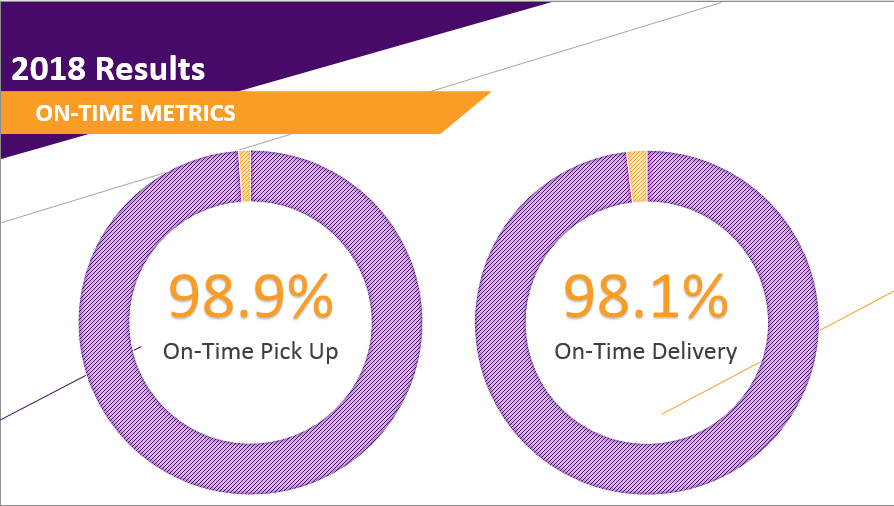
To maintain their bottom line, shippers are realizing the need for transportation providers that deliver on time. At Tucker, we’re thrilled! We’ve always prided ourselves on providing top-notch service. Our track and trace procedures are second to none and our on-time metrics speak for themselves:
However, we realize that we need to take it one step further to improve our shippers’ supply chain efficiency. To that end, we announced our freight visibility initiative late last year, ensuring that every shipment we book has real-time location visibility 24/7/365.
This type of connection (whether by ELD, TMS or app tracking) provides valuable reporting data right at your fingertips. It also opens up the doors for us to spend more time mining your shipment history to provide cost-saving recommendations and presenting opportunities for increased efficiency — a real value-add for our customers.
As a non-asset-based 3PL with carrier connections spanning the past 58 years, 100% visibility is no easy task — but we’re firm believers that it’s worth doing. Our internal cross-departmental committee is vetting technology partners, identifying non-compliant carriers, troubleshooting tracking connections, and designing a seamless customer experience, to make this important initiative a reality. Each month we announce our progress internally and reinforce the new procedures we’re implementing. We’ve made this quote our electronic visibility mantra: “We don’t grow when things are easy. We grow when we face challenges.” We’re excited to face this challenge, grow our base of shippers, and pioneer a new level of transportation service — once again!
Learn more about our commitment to digital, GPS-based truckload visibility.